Wallet Swap vs Exchange: Avoiding Hidden Fees
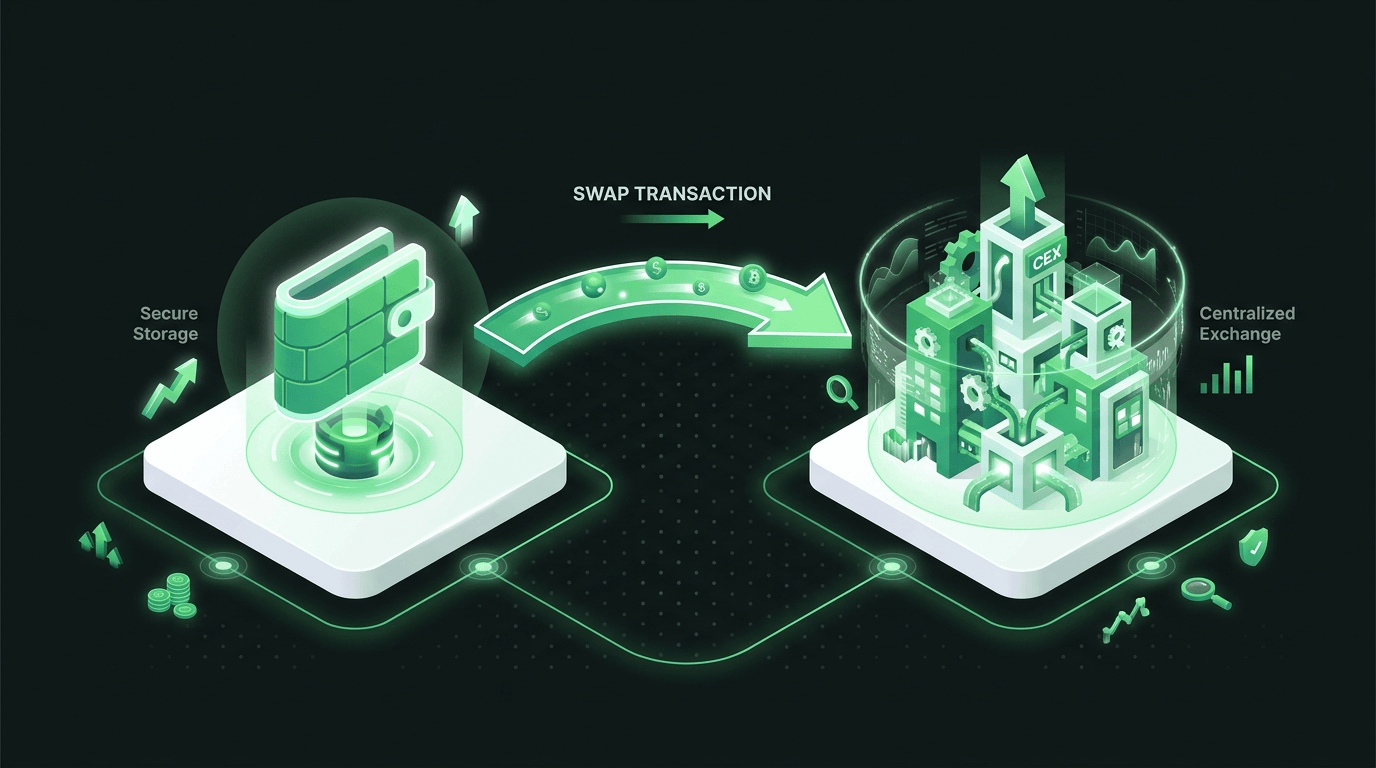
When comparing a wallet swap vs exchange, the biggest difference lies in the hidden convenience tax built into your wallet's interface. Clicking the "swap" button inside apps like Trust Wallet, MetaMask, or Ledger Live routes your trade through third-party partners who take an extra cut. To get the actual market rate, you are usually better off bypassing the wallet interface and using an external exchange directly.
The Mechanics of a Built-In Wallet Swap vs Exchange
Your hardware or software wallet does not execute trades itself. Wallets function strictly as key management software used to sign transactions on the blockchain. When you initiate a swap inside a wallet interface, the software simply connects via API to an external exchange service.
This means your wallet acts as a middleman between you and the actual swap provider. Companies like Consensys (MetaMask) or Ledger partner with specific third-party routing services to process these trades. Because the wallet developer integrated the API directly into your dashboard, they bake a revenue-sharing agreement into the code.
The end result is an additional percentage fee added directly to your trade, on top of what the underlying exchange already charges. You pay a premium simply for the convenience of not leaving the app. You also lose the ability to shop around for the most efficient routing paths.
Identifying the Hidden Fees in Wallet Swaps
Most users fail to notice the extra costs because wallet interfaces blend the fees into the final quoted price. A standard crypto transaction involves baseline network fees, like Ethereum gas or Bitcoin miner fees, required to record the transfer on the blockchain. But built-in swaps add two specific layers of hidden costs that drain your stack.
First, the wallet software exacts a flat service fee for facilitating the user interface. For example, MetaMask applies a service fee ranging from 0.875% to 1% on every swap executed through their dashboard [HUMAN VERIFY: exact current MetaMask swap fee percentage]. This fee pays for the software developer, not the blockchain network or the actual liquidity providers making the trade possible.
Second, users suffer from severe spread markup. The third-party exchange partner quoting the trade usually offers a worse exchange rate than the actual market price. When you swap BTC to ETH directly on an open market, you pay closer to the actual spot price. In a closed wallet interface, the API provider widens the spread to guarantee their own profit margin before sharing the rest with the wallet developer.
Using External Platforms to Avoid the Convenience Tax
Bypassing your wallet’s built-in feature and going straight to a dedicated exchange removes the wallet developer's cut entirely. You maintain control of your private keys for the entire storage lifecycle, but you execute the trade efficiently at the source. Understanding exactly how the swap process works on standalone non-custodial exchanges highlights why cutting out the middleman saves money.
With an independent non-custodial service like MistySwap, you generate a specific transaction order outside your wallet interface. You send your funds to the provided deposit address directly from your wallet, and you receive the swapped asset back to your chosen destination. You pay the standard network fees and the exchange's transparent rate without an extra middleman taking 1% for rendering a button on your screen.
For users executing larger trades, saving that 1% to 2% convenience tax amounts to significant capital. Removing the wallet interface from the routing equation ensures more of your cryptocurrency actually makes it to your destination address. It also allows you to separate your long-term cold storage interface from your active trading environments.
Steps to Compare Wallet Swap vs Exchange Rates
Before executing any trade, you should calculate the exact premium your wallet interface is charging for the privilege of using their button. Follow this checklist to compare a built-in wallet swap vs exchange quote and uncover the true cost of your trade:
- Open your wallet app and enter the exact amount you want to trade (e.g., 0.1 BTC).
- Note the exact final amount of the receiving token the wallet promises to deliver, completely ignoring the estimated dollar value.
- Open an external non-custodial exchange platform in your browser and enter the exact same starting amount.
- Compare the final receiving token amounts between the two platforms.
- Subtract the wallet's quoted payout from the external exchange's quoted payout to find the hidden convenience fee.
If the standalone exchange offers significantly more of the destination token, you are looking at the exact cost of the wallet's hidden spread. You can then make an informed decision on whether the convenience is worth the financial loss.
Privacy Risks Tied to Third-Party Wallet Integrations
Beyond the financial cost, using an in-app swap introduces serious privacy vulnerabilities for self-custody users. When you click swap, your wallet software shares your IP address, your full wallet balance, and your specific address history with the third-party API provider. You are no longer just broadcasting a transaction to a decentralized network; you are sending a detailed financial packet to a corporate server.
Worse, many of the fiat-to-crypto and crypto-to-crypto partners integrated into popular wallets employ aggressive, retroactive KYC (Know Your Customer) triggers. You might initiate a swap believing it is anonymous, only for the third-party partner to freeze the transaction mid-flight. The partner will then hold your funds hostage while demanding a passport scan, utility bills, and a selfie video.
Independent non-custodial exchanges with strict no-KYC policies prevent this custodial bait-and-switch. Because they do not require user accounts, they do not build invasive behavioral profiles tied to your primary cold storage addresses. If you want to check which assets you can trade directly without surrendering your ID to a third-party API, you can review all supported coins and networks directly on the exchange platform.
FAQ
Why do wallet apps charge extra for swaps?
Wallet developers offer their software for free and monetize their active user base by integrating third-party services. When you use the built-in swap button, the wallet provider takes a commission or revenue share from the exchange partner for routing your volume to them. This fee is automatically deducted from your final payout.
Are built-in wallet swap features safe to use?
Technically, they are secure because they still require you to sign the transaction with your private keys, meaning the wallet provider cannot steal your funds. However, you carry the counterparty risk of the specific third-party API processing the trade. That third party can freeze your assets if their automated risk systems flag your transaction for compliance reasons.
Do decentralized exchanges (DEXs) charge hidden fees?
Pure DEXs charge transparent network gas fees and a small liquidity provider fee (usually around 0.3%), but they do not charge arbitrary convenience fees. However, if you access a DEX through a wallet's built-in aggregator interface rather than the DEX's official front-end, your wallet software may still tack on a proprietary routing fee.
Can a non-custodial exchange freeze my funds?
A true non-custodial exchange processes trades instantly without holding user deposits in centralized accounts or custodial wallets. Once the blockchain confirms your incoming deposit transaction, the outbound transaction executes automatically based on the smart contract or backend routing logic. Platforms operating strictly without KYC requirements do not pause transactions to demand identity verification.
Informational only — not financial, legal, or tax advice.