Swap BTC to ETH Without KYC: A Guide
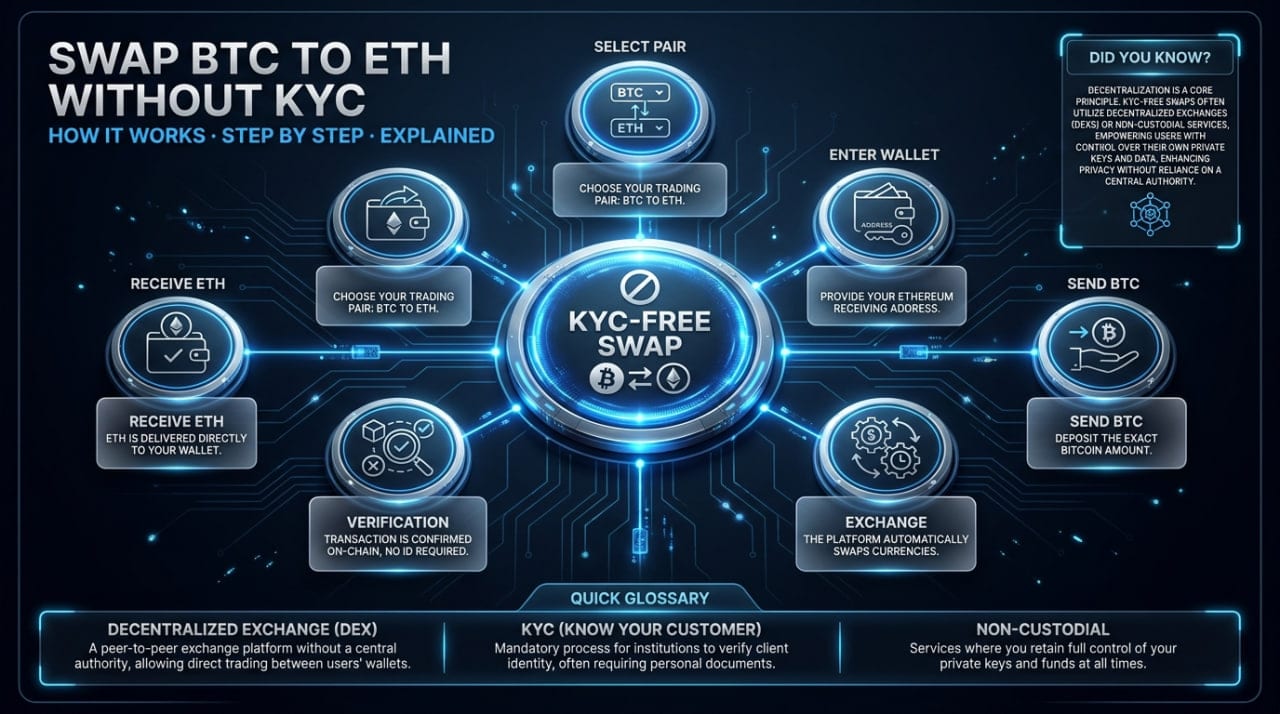
To swap BTC to ETH without KYC, you need a non-custodial exchange that bridges the Bitcoin and Ethereum networks directly. Instead of surrendering your ID to a centralized platform, you simply send Bitcoin from your self-custody wallet to a provided deposit address and receive Ethereum at your designated EVM address. This approach preserves your privacy and keeps your personal identity detached from your on-chain activity.
Why Swap BTC to ETH Without KYC?
Moving liquidity between the two largest blockchains usually involves a centralized exchange (CEX). CEXs require extensive identity verification, freeze accounts arbitrarily, and link your physical identity to your blockchain addresses forever. By choosing to swap BTC to ETH without KYC, you bypass these bottlenecks completely. You retain control of your private keys throughout the process, eliminating counterparty risk.
Furthermore, avoiding centralized platforms prevents blockchain analytics firms from easily tying your Bitcoin history to your Ethereum decentralized finance (DeFi) activities. When you withdraw from a CEX, the exchange logs your withdrawal address, IP address, and transaction timestamp. Using a decentralized or non-custodial bridging method breaks this direct surveillance link, keeping your UTXO history completely separate from your EVM footprint.
Wallet Preparation: UTXOs vs. EVM Accounts
Before initiating a cross-chain trade, you must prepare two separate self-custody wallets. Bitcoin operates on an Unspent Transaction Output (UTXO) model, meaning your wallet generates a new change address for every transaction to protect your privacy. Ethereum uses an account-based model, where all your ETH and ERC-20 tokens live under a single public address starting with "0x".
You will need your Bitcoin wallet ready to send the exact deposit amount and your Ethereum wallet ready to receive the funds. Hardware wallets like Trezor or Coldcard are ideal for securing the Bitcoin side, while a standard Web3 wallet like Rabby or MetaMask works well for receiving the Ethereum. Never use an exchange address as your receiving wallet, as centralized platforms often reject deposits from smart contracts or unknown sources.
Step-by-Step: How to Swap BTC to ETH Without KYC
Using a non-custodial service like MistySwap makes bridging these two fundamentally different networks straightforward. Because there are no accounts to create, the entire process happens directly between your wallets and the exchange's liquidity pools.
Follow these steps to complete the swap:
- Select Bitcoin (BTC) as your send currency and Ethereum (ETH) as your receive currency.
- Enter the exact amount of Bitcoin you want to exchange.
- Paste your self-custody Ethereum receiving address (starting with 0x).
- Send the exact BTC amount to the generated deposit address within the given time limit.
- Wait for the Bitcoin network to confirm your transaction.
- Receive the swapped ETH directly in your Ethereum wallet.
If you want to move your Bitcoin into the Ethereum ecosystem but prefer a stablecoin, you can also swap BTC to USDT using the exact same workflow.
Managing Transaction Speeds and Network Fees
When moving liquidity across these networks, the primary delay is the Bitcoin blockchain itself. Bitcoin blocks are mined approximately every 10 minutes, and non-custodial exchanges require at least one block confirmation before processing the trade. If the mempool is congested, your deposit might take longer to confirm unless you set a sufficient miner fee.
Once the Bitcoin transaction confirms, the Ethereum payout executes almost instantly since EVM blocks process every 12 seconds. Understanding how fees work on both networks helps you avoid underpaying miners and getting your deposit stuck. Always check current gas prices before initiating a cross-chain transfer to ensure you are not paying a premium during peak network congestion.
FAQ
How long does a cross-chain swap take?
A standard swap between Bitcoin and Ethereum takes roughly 15 to 30 minutes. This timeframe depends entirely on how quickly the Bitcoin network mines your deposit transaction. Once the deposit receives one confirmation, the Ethereum payout triggers within seconds.
Are there limits on how much I can swap?
Non-custodial exchanges rely on active liquidity pools, so maximum swap limits fluctuate based on available reserves. You can check all supported coins and networks and their current limits directly on the swap interface before initiating a trade. Minimum limits are also enforced to ensure the swapped amount covers the necessary network miner fees.
Does the exchange hold my funds during the swap?
No, non-custodial platforms do not hold user deposits long-term. You can learn more about how the swap process works to see how funds are routed. The service acts as an automated router: it detects your incoming Bitcoin, calculates the exchange rate, and immediately dispatches the equivalent Ethereum to your receiving address.
What happens if I send the wrong amount of Bitcoin?
If you send an amount different from what you specified during the setup, the swap protocol will usually recalculate the payout based on the actual deposit received. However, if you send an amount below the minimum required threshold, the transaction may fail to process. Always double-check the exact deposit amount and ensure your wallet is not deducting the network fee from the send amount.
Informational only — not financial, legal, or tax advice.