Convert Monero to Bitcoin Without KYC
To securely convert monero to bitcoin without linking your identity to the transaction, you must use a non-custodial swap service. This method allows you to exchange XMR for BTC directly between your own self-custody wallets, entirely bypassing centralized exchanges that require ID verification. By managing your receiving addresses carefully, you can preserve the privacy benefits of Monero even after entering Bitcoin's transparent ledger.
The Privacy Shift When You Convert Monero to Bitcoin
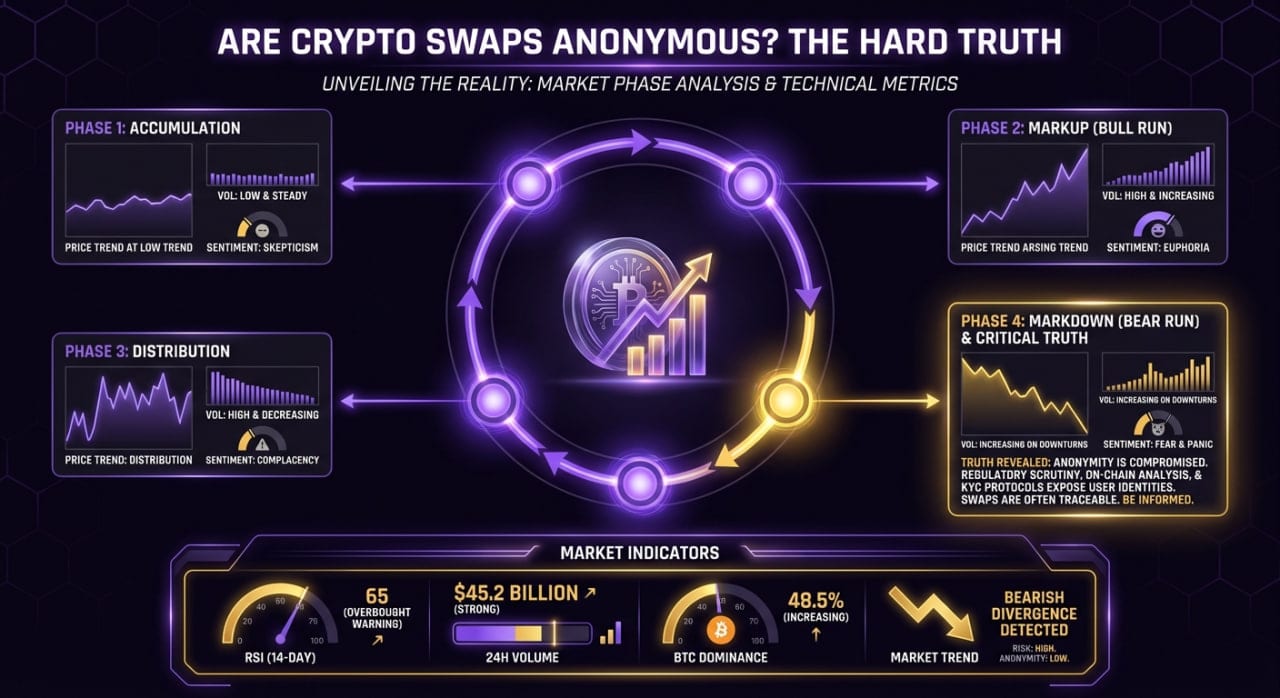
Monero (XMR) shields the sender, receiver, and transaction amounts by default using ring signatures and stealth addresses. Bitcoin (BTC), however, operates on a completely transparent public ledger where anyone can trace the history of a coin. Chain surveillance tools actively monitor the Bitcoin blockchain to link addresses to real-world identities.
When you move funds from a privacy network to a transparent one, the primary risk is doxing your new Bitcoin UTXO (Unspent Transaction Output). If you send the resulting BTC to an exchange account tied to your real name, the privacy gained by holding Monero is instantly broken. To maintain operational security, you must isolate the swapped funds in a dedicated self-custody wallet.
Choosing the Right Wallets for the Swap
Before you initiate a trade, you need reliable self-custody software for both assets. For Monero, desktop clients like Feather Wallet or mobile options like Cake Wallet provide excellent control over your nodes and transaction outputs. For Bitcoin, use a wallet that supports coin control, such as Sparrow Wallet or Electrum.
Coin control allows you to label the specific Bitcoin UTXO you receive from the swap, ensuring you do not accidentally merge it with KYC-tainted coins in the future. Connecting these wallets to your own personal node ensures you do not leak your IP address or transaction broadcast data to third-party servers.
Steps to Convert Monero to Bitcoin Without KYC
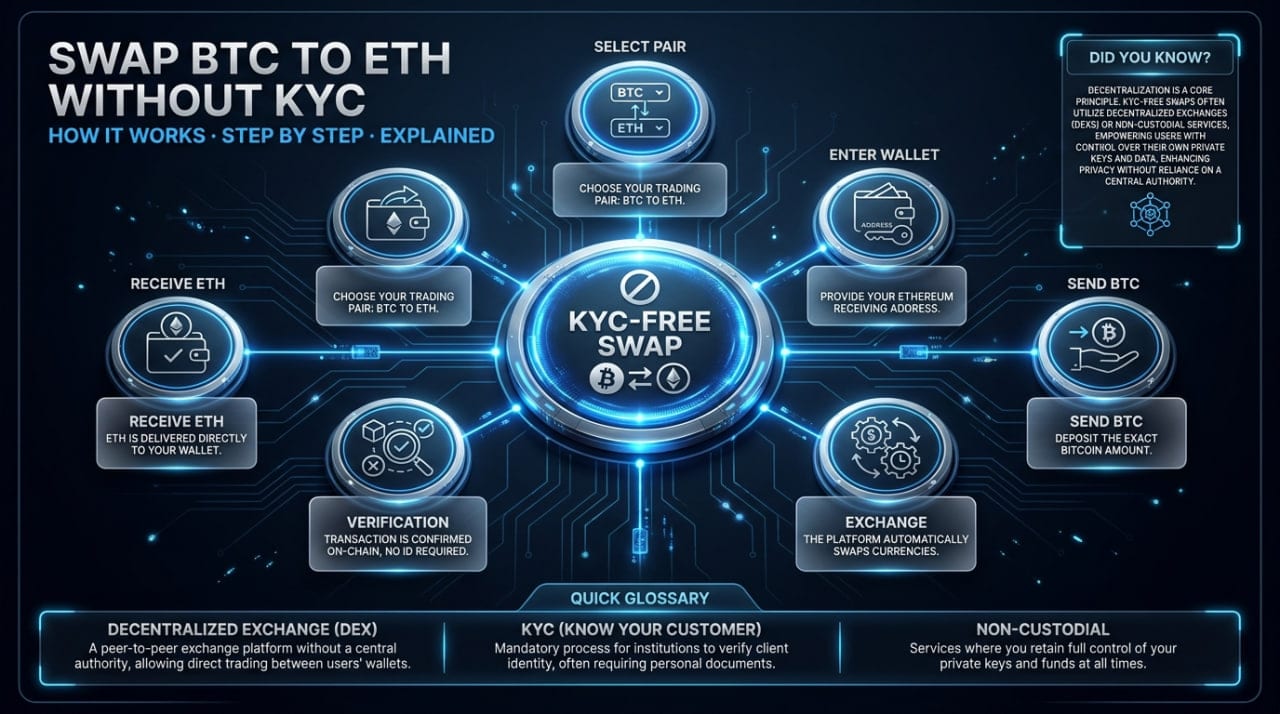
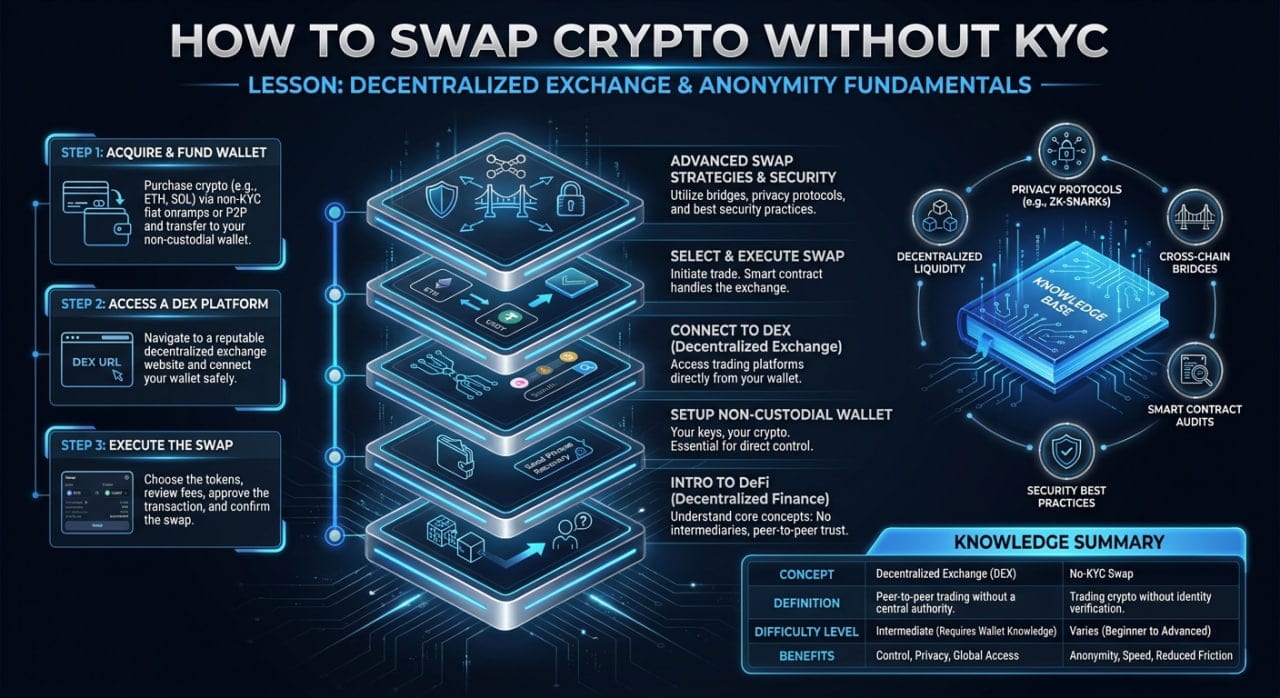
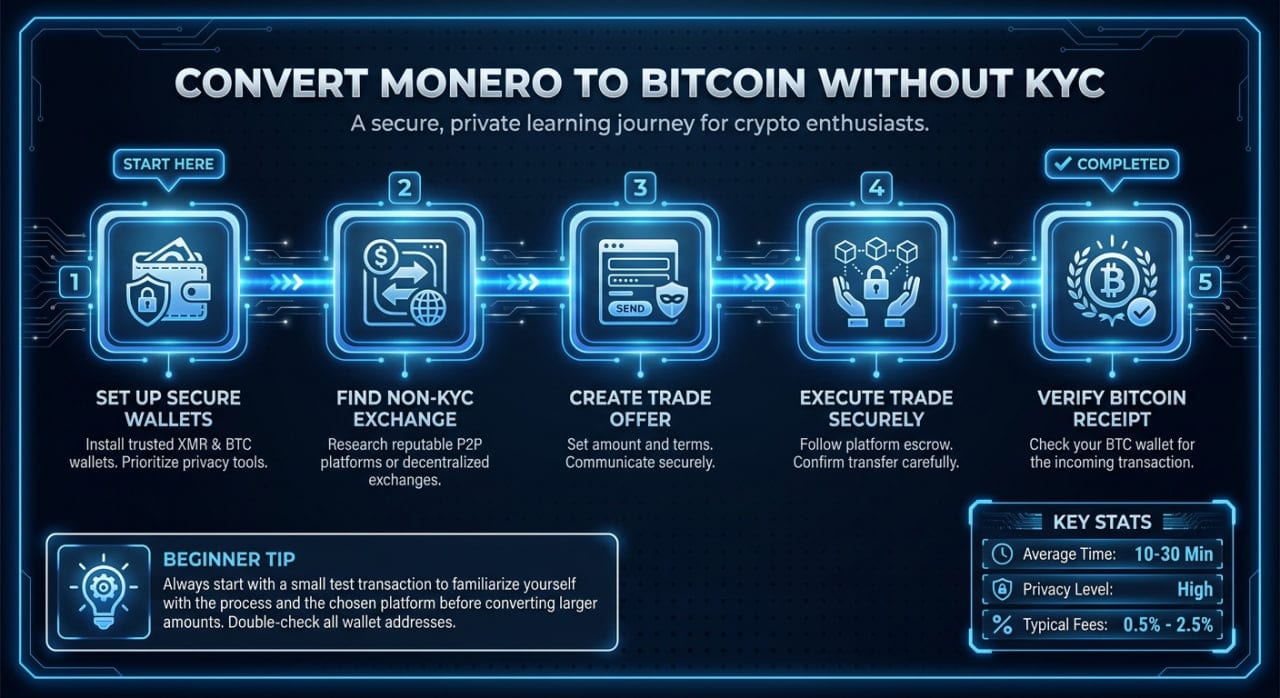
Using a non-custodial exchange like MistySwap means you never create an account or hand over custody of your keys. You simply generate a swap order, send your XMR, and receive BTC directly to your chosen address. Here is the exact process to execute the swap safely:
- Generate a brand new, unused receiving address in your self-custody Bitcoin wallet.
- Enter this new Bitcoin address into the non-custodial swap interface as your destination.
- Copy the exact XMR deposit address and the required payment amount provided by the swap service.
- Send the XMR from your Monero wallet to the provided deposit address.
- Wait for the Monero network to confirm the transaction (usually 10 block confirmations).
- Receive the newly swapped BTC directly into your self-custody Bitcoin wallet.
Managing Network Confirmations and Timings
Understanding how the swap process works helps you anticipate transaction times and avoid unnecessary panic. Monero blocks take roughly two minutes to mine, and most non-custodial services require 10 network confirmations before they release the Bitcoin. This means you should expect the XMR deposit phase to take about 20 minutes.
Once the exchange verifies the deposit, they broadcast the Bitcoin transaction to the mempool. The final arrival time depends on the current Bitcoin network congestion and the miner fee attached to the outgoing transfer. Your Bitcoin wallet will show the incoming transaction as "unconfirmed" until a miner includes it in the next Bitcoin block.
Best Practices for Your New Bitcoin UTXOs
Once you convert your XMR, the resulting Bitcoin sits at a specific address on the public ledger. Never reuse this address for future swaps or incoming payments. Address reuse clusters your transactions together, making it trivial for blockchain analysis firms to map your financial activity.
If you eventually plan to swap BTC to ETH or another asset, keep those funds isolated from your main cold storage stack. Treat every swap output as a quarantined asset until you are ready to spend it. Labeling your transactions clearly in your wallet software will prevent accidental mixing months or years down the line.
FAQ
How long does a Monero to Bitcoin swap take?
The entire process generally takes 20 to 40 minutes. The bulk of this time is spent waiting for the Monero network to process 10 block confirmations for your deposit. Once confirmed, the Bitcoin is sent immediately, though it will remain unconfirmed in your wallet until the next Bitcoin block is mined.
Can a non-custodial exchange freeze my XMR?
Because non-custodial services do not hold user accounts or require KYC, the risk of frozen funds is drastically lower than on centralized platforms. However, if you send the wrong amount or send funds after an order expires, the automated swap will fail. In these cases, the service will refund the XMR to the return address you provided during the order creation.
Do I need a fresh Bitcoin address for every swap?
Yes, generating a new receiving address for every single transaction is a fundamental rule of Bitcoin privacy. Reusing an address links your new swap to your previous financial history, destroying the anonymity you gained by using Monero. Modern HD (Hierarchical Deterministic) wallets generate an infinite number of fresh addresses automatically.
How do swap fees work for XMR to BTC?
When executing a cross-chain swap, you pay the Monero network fee to send your deposit, the exchange's routing spread, and the Bitcoin miner fee for the final delivery. You can review how fees work to understand the exact breakdown before initiating a trade. Always ensure your Monero wallet has a tiny fraction of extra XMR to cover the initial outgoing network fee.
Informational only — not financial, legal, or tax advice.