Is It Safe to Reuse Bitcoin Address? Risks
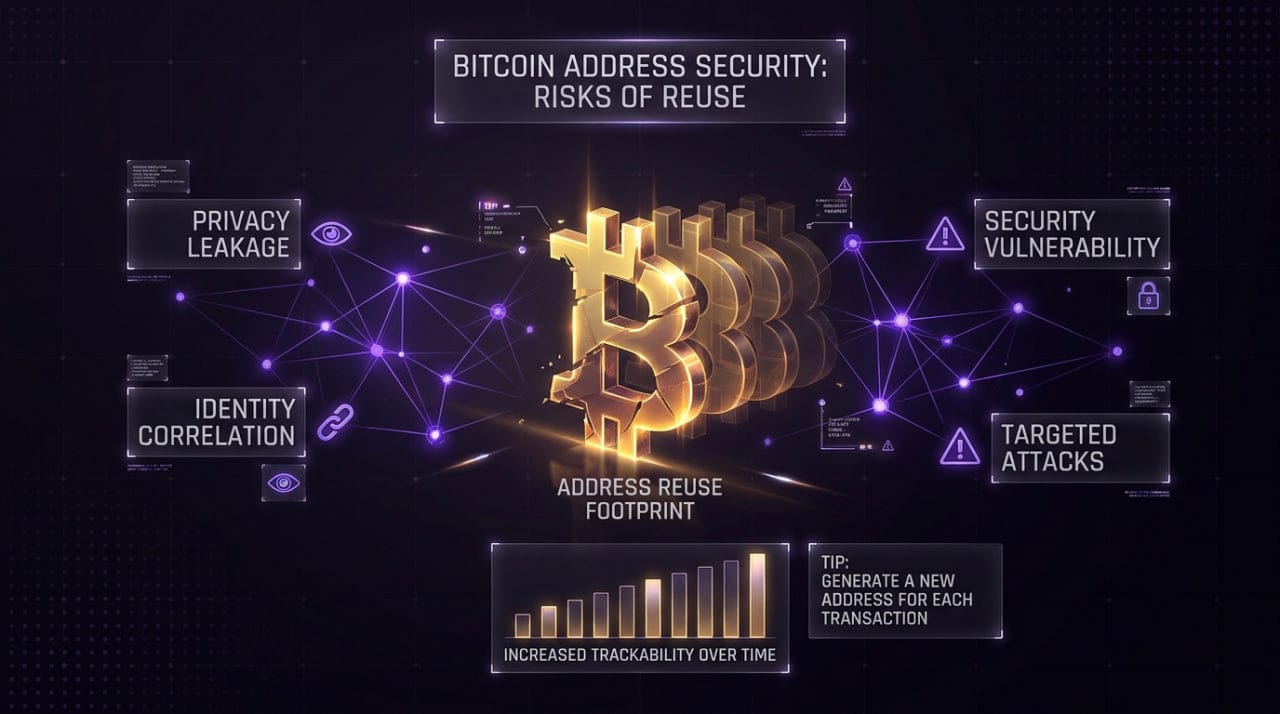
Many crypto users wonder if it is safe to reuse bitcoin address for multiple incoming payments. While your funds remain technically secure from hackers, reusing addresses completely destroys your on-chain pseudonymity. Anyone who knows that address belongs to you can track your entire financial history, real-time balance, and future spending habits using a public block explorer.
Why It Is Not Safe to Reuse a Bitcoin Address for Privacy
Bitcoin is not an anonymous network; it is a transparent, public ledger. Every transaction, timestamp, and wallet balance is permanently recorded on the blockchain for anyone to download and view. When you use a single address for multiple transactions, you are voluntarily clustering your own financial data.
If you receive your salary and then buy a cup of coffee using the same address, the merchant can look up your exact net worth before handing you your drink. Even worse, if you ever attach your real identity to that address through a centralized exchange, your entire transaction history is exposed to that company. They can see exactly where you sent your funds and who sent funds to you.
How Chain Analysis Tools Exploit Address Reuse
Chain analysis firms build their entire business models around user mistakes like address reuse. They use clustering heuristics to connect different transactions to a single real-world identity. Once you withdraw from an exchange that requires ID verification, that specific withdrawal address is permanently linked to your legal name in their database.
If you then hand that same static address out to a friend or a merchant, you bridge your private financial life with your known identity. Tools like Chainalysis and Elliptic scrape this public data to map out relationships between supposedly private wallets. Simply generating a new receiving address for every incoming transaction breaks this easy data link.
Modern Bitcoin wallets make this privacy practice automatic by giving you a fresh string of alphanumeric characters every time you click "Receive."
How to Stop Reusing Bitcoin Addresses
Breaking the habit of using a single static address requires a few minor adjustments to how you handle your funds. Almost all modern Bitcoin wallets use Hierarchical Deterministic (HD) architecture, meaning they mathematically generate billions of unique addresses from a single master seed phrase. You just need to let the wallet software do its job.
Follow these steps to prevent accidental address reuse:
- Open your self-custody Bitcoin wallet and navigate to the receive tab.
- Verify that the wallet displays a fresh address string compared to your last transaction.
- Copy this new address and provide it directly to the sender.
- Never post a static Bitcoin address on a public social media profile or website.
- Apply text labels to your receiving addresses inside your wallet software to track their exact origins.
- Delete old withdrawal addresses saved in your centralized exchange address books so you do not use them twice.
Security Vulnerabilities of Reusing Bitcoin Addresses
Beyond massive privacy erosion, reusing addresses introduces specific technical security risks regarding cryptography. When you send Bitcoin, you must reveal the public key associated with your address to the network to broadcast the transaction. Until you spend from an address, only its hash is public, which masks the actual underlying public key.
By repeatedly receiving and spending from the exact same address, your public key remains permanently exposed on the blockchain. While the cryptography securing Bitcoin is currently unbreakable, future advancements in quantum computing could theoretically derive a private key from a known public key. Using a fresh address ensures your public key stays hidden securely behind a cryptographic hash until the exact moment you spend those specific funds.
Preserving Privacy During Crypto Swaps
When trading between different networks, using a service that respects your privacy mechanics is highly practical. Centralized platforms often force you to reuse static deposit addresses tied directly to your government identity. Conversely, you can maintain your pseudonymity by using non-custodial, No-KYC services like MistySwap.
Because MistySwap operates without accounts or identity verification, you can easily generate a fresh destination address for every single trade. For example, if you decide to swap BTC to ETH, you simply provide a brand new Ethereum receiving address from your hardware wallet. Once you understand how the swap process works, you can systematically route swapped assets to isolated addresses, preventing blockchain observers from linking your cross-chain activity together.
FAQ
Does reusing an address cost more in network fees?
No, receiving funds to the same address does not directly impact the network fees you pay. However, when you eventually spend that Bitcoin, your wallet must combine multiple incoming deposits, known as unspent transaction outputs (UTXOs), into one transaction. Consolidating many small UTXOs requires more block space, which results in higher miner fees regardless of whether those UTXOs sit on one address or fifty.
Can I send from multiple addresses at once?
Yes, your wallet automatically handles this process behind the scenes. When you send a payment that exceeds the balance of a single address, the wallet combines UTXOs from multiple addresses you control to fund the transaction. Be aware that this process, called the common-input ownership heuristic, proves to blockchain observers that all those addresses belong to the exact same person.
Do hardware wallets automatically generate new addresses?
Yes, modern hardware wallets like Trezor, Ledger, and Coldcard utilize HD wallet standards. Every time you view your receiving QR code or copy your address, the companion software displays a newly generated address mathematically derived from your master seed phrase. You do not need to back up anything new when a new address is created.
What happens if someone sends Bitcoin to an old address?
You will still receive the Bitcoin perfectly fine and maintain full control over the funds. Old addresses generated by your seed phrase remain valid forever on the blockchain network. The only downside to receiving funds on a previously used address is the immediate loss of privacy for both you and the sender.
Informational only — not financial, legal, or tax advice.