Can USDC Be Frozen in Your Wallet?

If you hold USD Coin (USDC) in a self-custody wallet, you might assume you have absolute control over your money. However, the short answer to whether can USDC be frozen in your wallet is yes. Circle, the centralized company behind the stablecoin, maintains an administrative backdoor in the USDC smart contract. This backdoor allows them to blacklist specific public addresses and lock the funds instantly, rendering the tokens completely immovable regardless of what wallet software or hardware you use.
How Can USDC Be Frozen by Circle?
Understanding the technical mechanics behind a freeze requires looking at how tokens operate on a blockchain. USDC is primarily an ERC-20 token on the Ethereum network, though it exists natively on many other chains. The smart contract that dictates how USDC functions contains a specific administrative command known as a blacklist function.
When Circle adds a blockchain address to this blacklist, that specific address is blocked at the protocol level from executing any transfers. You will still be able to view your USDC balance in your wallet interface. However, any attempt to send those tokens to another user, deposit them to an exchange, or swap them on a decentralized exchange (DEX) will fail.
The blockchain will reject the transaction outright, returning a smart contract error. This incredible power rests entirely with a multi-signature administrative wallet controlled by Circle. Because the ledger is immutable and the smart contract rules are absolute, no wallet provider or third-party service can bypass this restriction once the blacklist command is executed.
Why Would Your USDC Address Get Blacklisted?
Circle does not arbitrarily freeze user funds for fun; they execute these freezes to comply with legal and regulatory mandates. The company operates within the traditional financial system to maintain its dollar peg, meaning it must strictly adhere to the laws of the jurisdictions in which it is based.
The most common trigger for a freeze is a direct order from law enforcement or inclusion on a government sanctions list. The most prominent example is the US Treasury’s OFAC (Office of Foreign Assets Control) list. When the US government sanctions a specific blockchain address, Circle is legally obligated to freeze any USDC sitting in that wallet immediately.
Tornado Cash users discovered this firsthand in 2022. When OFAC sanctioned the decentralized mixing service, Circle preemptively froze millions of dollars in USDC sitting in addresses directly associated with the protocol. Funds can also be locked if they are definitively linked to major exchange hacks, exploits, or ongoing criminal investigations where a court order forces Circle’s hand.
How to Check if Your Address Is Frozen
If a transaction keeps failing and you suspect Circle took action against your wallet, you can verify your status directly on the blockchain. Since the USDC smart contract is public, anyone can query its state using a block explorer.
Here is how to check if your address is blacklisted on Ethereum:
- Open Etherscan and search for the official USDC smart contract address.
- Click on the "Contract" tab, then select the "Read as Proxy" button to view the contract's readable functions.
- Scroll down the page until you find the function labeled
isBlacklisted. - Paste your public Ethereum address into the input field and click the "Query" button.
- If the result returns a boolean value of "true", your address is frozen and the funds are permanently locked.
Decentralized Alternatives When You Cannot Risk Frozen USDC
For privacy-conscious users, the reality that a centralized corporation can freeze a self-custodial wallet defeats the primary purpose of cryptocurrency. If financial sovereignty and censorship resistance are your top priorities, you must pivot to decentralized stablecoins that lack administrative freeze functions.
DAI is currently the most widely adopted alternative, managed by the MakerDAO protocol through decentralized governance rather than a corporate boardroom. While DAI is partially backed by centralized assets, the DAI smart contract itself does not contain any function to blacklist individual user addresses. This means no single entity can stop you from moving your DAI once it is in your custody.
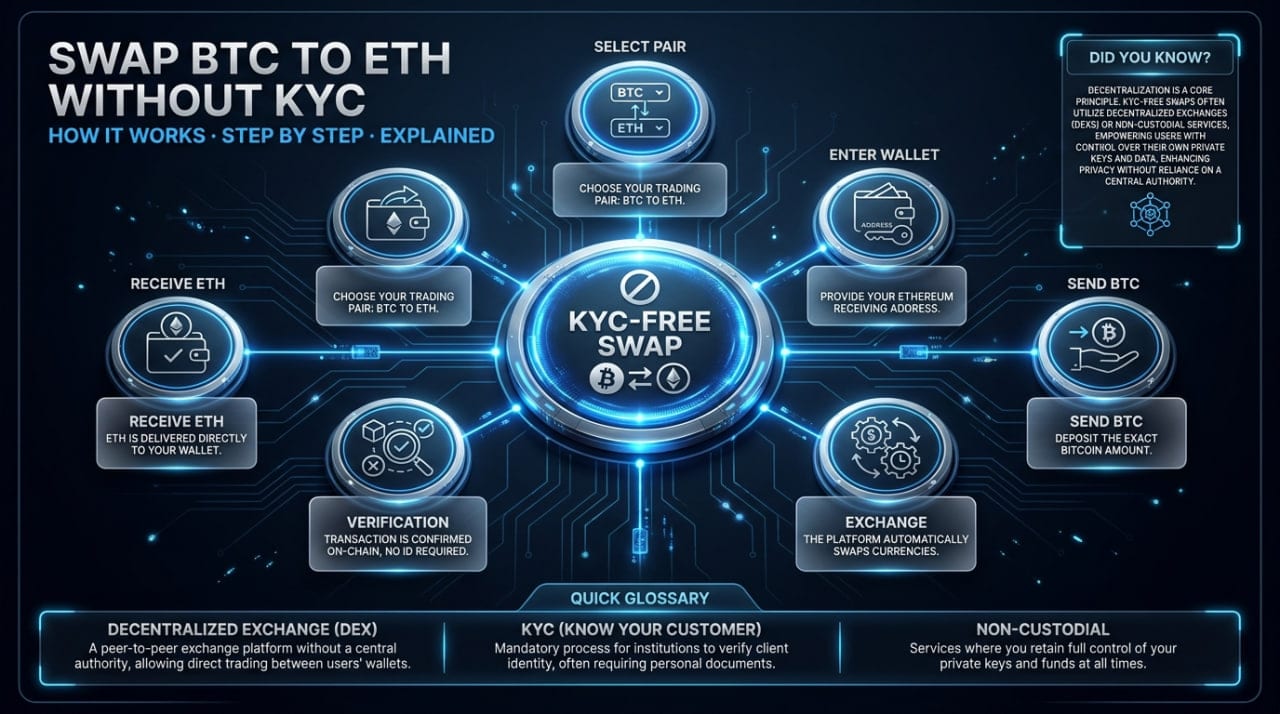
You can seamlessly transition away from centralized risk by using a no-KYC platform like MistySwap to swap BTC to DAI or shift your assets entirely into permissionless networks. Because MistySwap operates non-custodially, how the swap process works ensures you remain in complete control of your private keys until the new decentralized asset safely arrives in your wallet.
Protecting Your Privacy Before Interacting With Stablecoins
If you absolutely must use USDC for liquidity purposes or specific DeFi applications, isolating your on-chain identity is the best defense against targeted surveillance. Chain analysis firms monitor transaction hops, looking for obvious links between known identities and high-value wallets.
Avoid funding a new private wallet directly from an exchange linked to your real identity. Centralized exchanges keep permanent records of withdrawal addresses, creating a direct, undeniable link between your KYC documents and your entire on-chain history. Once that link is established, any subsequent interaction your wallet has with a flagged protocol could put your funds at risk of collateral freezing.
Instead, break the heuristic link by utilizing fresh addresses and completely avoiding address reuse. You can send a volatile asset like Bitcoin to an instant, accountless swap service, receiving your stablecoins at a completely unlinked Ethereum address. For example, you could swap BTC to USDC straight into a brand-new hardware wallet address that has never touched a centralized exchange, ensuring your on-chain footprint remains entirely isolated.
FAQ
Can USDC be frozen on hardware wallets like Ledger or Trezor?
Yes, hardware wallets do not protect against smart contract freezes. A Ledger or Trezor simply holds the private keys required to cryptographically sign a transaction. If the USDC smart contract prevents your address from sending funds, the hardware wallet cannot override the contract's rules.
Does Circle freeze USDC on Layer 2 networks like Arbitrum or Polygon?
Yes, the freeze capability exists across all native deployments of USDC. Whether you hold the stablecoin on Ethereum, Arbitrum, Optimism, Solana, or Polygon, Circle maintains the administrative keys necessary to blacklist addresses on those specific networks.
What happens to the fiat backing frozen USDC?
When an address is blacklisted, the tokens remain dormant on the blockchain, but the equivalent fiat backing them in Circle’s bank accounts is effectively quarantined. In cases of legal forfeiture or law enforcement seizure, Circle may eventually burn the frozen tokens and transfer the underlying fiat directly to authorities.
Can USDT be frozen just like USDC?
Yes, Tether (USDT) operates with a nearly identical smart contract structure. Tether Limited holds administrative keys that allow them to add addresses to a global blacklist, and they routinely freeze funds linked to hacks, scams, and international government sanctions.
Informational only — not financial, legal, or tax advice.