BIP39 Passphrase vs Seed Phrase
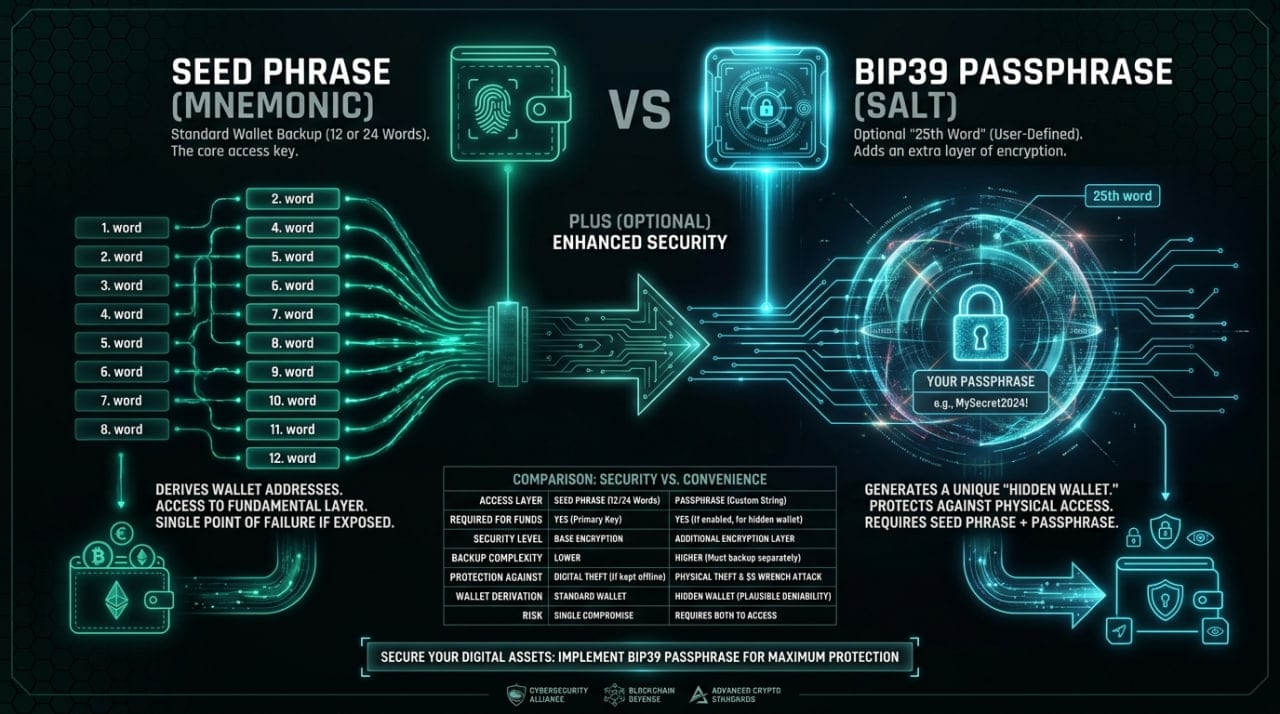
When analyzing the security of a BIP39 passphrase vs seed phrase, you are looking at two distinct components of modern crypto custody. A seed phrase provides the mathematical base entropy for your wallet, while a passphrase acts as an optional, user-generated cryptographic salt. Understanding this distinction is vital for protecting your self-custody funds against physical theft of your backups without accidentally locking yourself out of your own assets.
BIP39 Passphrase vs Seed Phrase: The Core Technical Difference
Your hardware or software wallet randomly generates your 12 or 24-word seed phrase upon setup. It acts as the master key, derived from a standardized list of 2048 specific English words. If a thief finds the metal plate or paper containing these words, they gain total control over the base wallet.
A BIP39 passphrase—frequently called the "25th word"—is an optional text string you append to this base setup. When you combine the seed phrase with a passphrase, the wallet applies a PBKDF2 cryptographic stretching function to hash them together. This calculation creates a completely independent master seed. You are not adding a password to lock your existing addresses; you are generating a parallel universe of entirely new deposit addresses.
Comparing BIP39 Passphrase vs Seed Phrase Rules
A seed phrase strictly adheres to the official BIP39 dictionary. If you misspell "abandon" as "abandan" on your backup, recovery software can easily auto-correct the mistake through checksums and brute force because the available word options are finite.
A passphrase has zero dictionary limits and zero built-in error correction. It accepts any string of ASCII characters including letters, numbers, spaces, and punctuation. It is also rigidly case-sensitive. Typing "Bitcoin2024" and "bitcoin2024" will generate two completely unrelated master seeds. This lack of error correction makes the passphrase highly secure against external attackers, but highly dangerous for careless users.
How Passphrases Build Plausible Deniability
The main reason privacy-focused users explore advanced setups is to achieve plausible deniability against a physical "$5 wrench attack." Because every conceivable passphrase generates a mathematically valid wallet, you can maintain multiple accounts under one device.
Users typically create a "decoy" wallet on the base seed phrase containing a modest amount of cryptocurrency. They then secure their primary funds behind the hidden passphrase wallet. If an attacker physically forces you to surrender your backup, they access the decoy funds and assume they drained your account. The blockchain offers no evidence that the hidden passphrase addresses even exist. This remains a common setup for users routing transactions through No-KYC services like MistySwap, where how the swap process works requires zero identity verification and relies entirely on keeping your final destination addresses unlinked from known hardware.
The Catastrophic Risk of Passphrase Loss
Adding a 25th word introduces a massive, irrecoverable point of failure into your backup protocol. If you forget your passphrase, or even forget whether one specific letter was capitalized, those funds permanently disappear. Your base 24-word seed phrase cannot help you access the passphrase-derived accounts.
Consequently, users must treat the passphrase with the exact same level of physical security as the seed phrase itself. The golden rule is to never store them in the exact same physical location. If a burglar finds your seed phrase and your passphrase tucked into the exact same fire safe, the extra security is completely compromised. If you plan to swap BTC to USDC and hold it in cold storage long-term, thoroughly test the entire wipe-and-restore process before routing a large deposit.
Checklist for Securing a Passphrase Wallet
To safely set up and test your BIP39 passphrase without risking permanent loss of funds, follow these exact steps:
- Generate your 12 or 24-word seed phrase and document it securely.
- Create a strong, high-entropy passphrase containing words, spaces, and numbers.
- Enter the base seed phrase and the new passphrase into your hardware wallet.
- Generate a receive address from the newly created wallet and copy it down.
- Wipe the hardware wallet back to factory settings.
- Restore the wallet using both your seed phrase and passphrase to verify the exact receive address matches.
FAQ
Can I add a passphrase to an existing wallet?
No, you cannot retroactively protect existing addresses. Adding a passphrase shifts the underlying math, generating a brand new, empty wallet. To use a passphrase, you must generate the new wallet and manually transfer your assets to the new deposit addresses via standard blockchain transactions.
Is a BIP39 passphrase just a PIN or password?
No. A PIN or password decrypts a local device or software application, like unlocking a hardware device or opening a mobile app. A BIP39 passphrase actually alters the cryptographic generation of the master seed itself. You can attach infinite passphrases to one base seed phrase, with each string unlocking a different account.
What happens if I type the wrong passphrase?
Your wallet software will not reject the entry or show an error message. Instead, the wallet will instantly open a perfectly valid, entirely empty wallet derived from that incorrect text string. If you log in and see a zero balance with zero transaction history, you almost certainly made a typo in your passphrase.
How long should my 25th word be?
A strong passphrase requires enough entropy to stop dictionary brute-force attacks if a thief acquires your base seed phrase. Security experts generally recommend a passphrase of at least 15 to 20 characters. The most effective method involves stringing together a short, random sentence using spaces, numbers, and mixed capitalization.
Informational only — not financial, legal, or tax advice.