Is Litecoin Anonymous? MWEB Explained
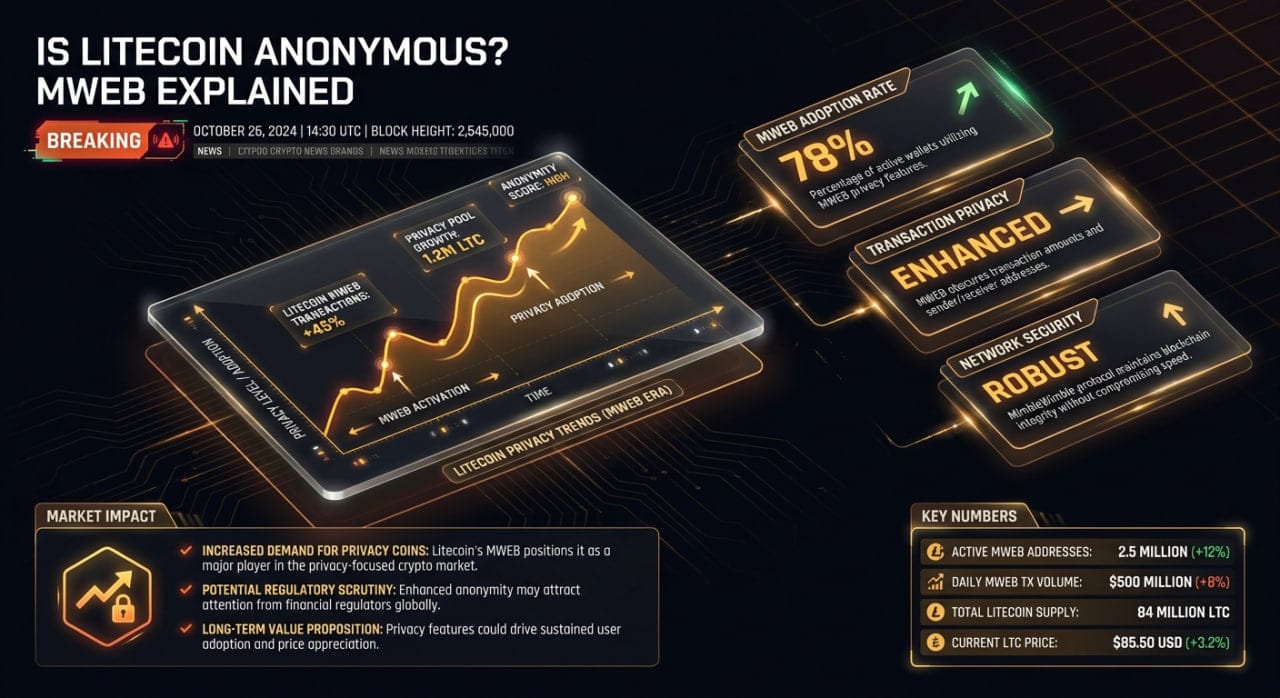
When privacy advocates ask, "is Litecoin anonymous?", the short answer is no—at least not by default. Standard Litecoin transactions operate on a fully transparent public ledger, making them just as traceable as Bitcoin. However, the network's MimbleWimble Extension Blocks (MWEB) upgrade introduced an opt-in privacy layer that allows users to hide transaction amounts and wallet balances.
Understanding the difference between Litecoin's base layer and its MWEB extension is critical for anyone trying to maintain financial privacy. Here is exactly how Litecoin handles your transaction data and how its privacy features stack up against dedicated privacy coins.
Is Litecoin Anonymous on the Base Layer?
By default, Litecoin uses the same Unspent Transaction Output (UTXO) model as Bitcoin. Every time you send or receive standard LTC, the transaction is broadcast to a public blockchain. Anyone with an internet connection can paste your Litecoin address into a block explorer and view your entire transaction history, your current balance, and the exact time you moved your funds.
Because the base layer is completely transparent, chain surveillance firms actively monitor the Litecoin network. They use clustering heuristics to link different addresses belonging to the same user. If you withdraw LTC from a centralized exchange that requires identity verification, that exchange knows your starting address and can track where you send those funds.
Address reuse makes this tracking even easier. If you post a static Litecoin donation address on a public profile, every incoming and outgoing transaction creates a permanent, public map of your financial activity. On the base layer, Litecoin offers pseudonymity, not anonymity.
How the MWEB Upgrade Hides Transaction Data
To address these privacy shortcomings, Litecoin activated the MimbleWimble Extension Blocks (MWEB) upgrade in 2022. MWEB functions like a parallel highway running next to the main Litecoin blockchain. Users can move their standard LTC onto this private highway through a process called "pegging in," and move it back to the public chain by "pegging out."
When you transact within the MWEB layer, the protocol uses cryptographic blinding factors to obscure the transaction amounts. If an outside observer looks at an MWEB block, they can see that a transaction occurred, but they cannot see how much Litecoin was sent. They also cannot see the balances of the participating MWEB addresses.
Furthermore, MWEB utilizes a feature called "cut-through." Instead of recording every single transaction input and output permanently, the protocol aggregates transactions within a block and deletes redundant data. This prevents observers from easily mapping the exact flow of funds from sender to receiver, breaking the clear transaction graph that exists on the base layer.
Litecoin MWEB vs. Monero: Is Litecoin Anonymous Enough?
While MWEB provides a massive privacy upgrade over standard Litecoin, it does not offer the same level of anonymity as Monero (XMR). Monero is private by default, meaning every single transaction on the network hides the sender, the receiver, and the amount. Because privacy is mandatory, Monero has a massive anonymity set—every user is hiding in the same crowd.
Litecoin MWEB is strictly opt-in. The vast majority of Litecoin transactions still occur on the transparent base layer. Because only a small percentage of users utilize MWEB, the anonymity set is significantly smaller. If you peg into MWEB and immediately peg out to a different address, a chain analyst might correlate the timing and amounts to link your old and new public addresses.
Additionally, MWEB primarily focuses on hiding transaction amounts. It does not use ring signatures or stealth addresses by default to completely sever the link between sender and receiver the way Monero does. If your threat model requires absolute, unbreakable privacy, Monero remains the industry standard. If you simply want to prevent casual observers from seeing your wallet balance while enjoying low network fees, MWEB is a highly practical tool.
How to Use Litecoin MWEB for Better Privacy
To utilize Litecoin's privacy features, you cannot use a standard hardware wallet or basic mobile app, as most do not yet support the extension blocks. You must use an MWEB-compatible wallet, such as Litecoin Core or Cake Wallet.
Here is how you move funds into the private layer:
- Download and sync an MWEB-compatible wallet.
- Generate a new MWEB receiving address (these addresses begin with
ltcmweb1instead of the standardLorM). - Send standard LTC from your public address to your new MWEB address to "peg in" to the extension block.
- Wait for the network confirmations; your funds are now shielded, and your balance is hidden from public block explorers.
- Transact directly with other MWEB addresses to maintain privacy, or "peg out" by sending funds back to a standard public address when necessary.
Acquiring Litecoin Without Sacrificing Privacy
Even if you use MWEB, buying Litecoin on a regulated exchange permanently links your real-world identity to your initial purchase. To maintain better operational security from the start, many privacy-conscious users prefer to acquire crypto through decentralized or non-custodial platforms.
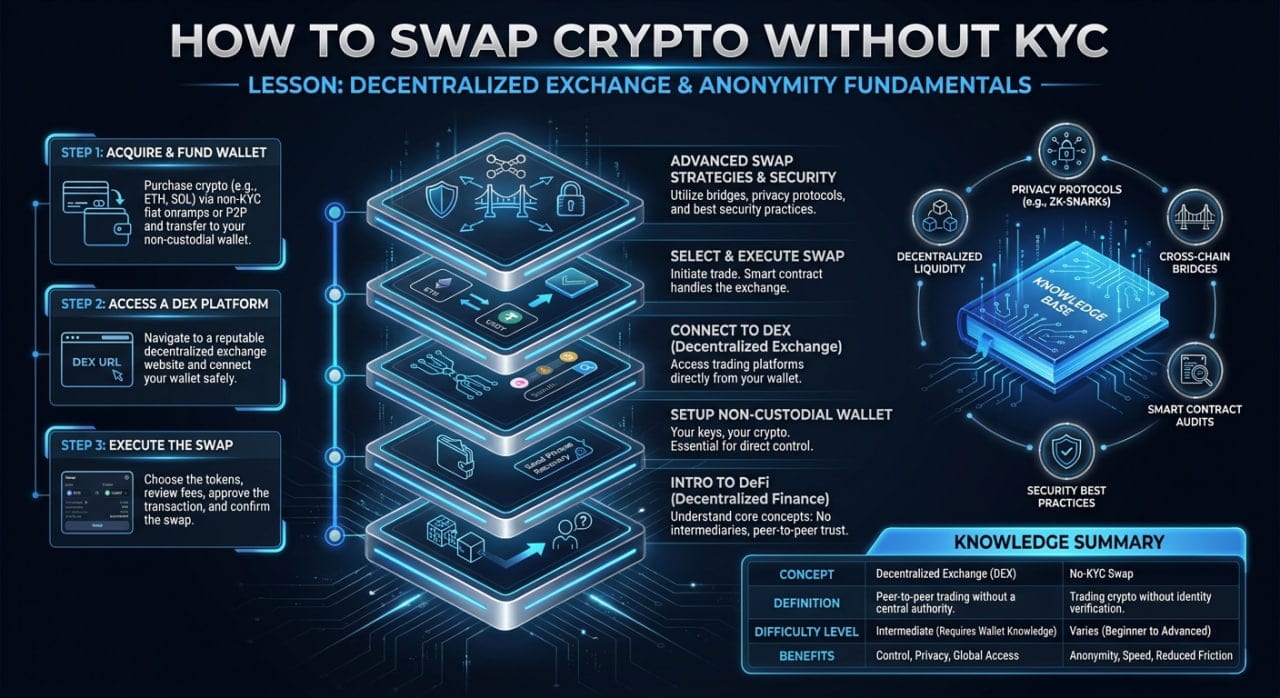
If you already hold another cryptocurrency, you can use a No-KYC instant swap service like MistySwap to trade for Litecoin. Because the platform is non-custodial, you simply send your deposit and receive the swapped LTC directly to your self-custody wallet. You can read how the swap process works to see how this prevents your funds from being held in a centralized exchange wallet.
When swapping, you can check all supported coins and networks to find the most efficient trading pairs. Keep in mind that you will still need to pay standard miner fees for the network you are sending from, so understanding how fees work on different chains can help you minimize the cost of acquiring your LTC. Once the standard LTC hits your wallet, you can immediately peg it into MWEB to shield your balance.
FAQ
Can centralized exchanges track my Litecoin MWEB transactions?
If you send funds directly from an exchange to an MWEB address, the exchange will know the exact amount you withdrew and the destination address. However, once the funds are inside the MWEB layer, the exchange cannot see subsequent transfers or your ongoing wallet balance. Note that most major exchanges do not currently support direct MWEB withdrawals or deposits.
Does MWEB hide my IP address?
No, MWEB only encrypts transaction amounts and aggregates block data. When you broadcast a transaction, your IP address can still be logged by the nodes you connect to. To protect your physical location, you should route your wallet connection through Tor or a trusted VPN.
Why do some wallets not support Litecoin MWEB?
Implementing MWEB requires significant development work and node infrastructure. Mobile wallets in particular struggle with MWEB because syncing the extension blocks requires more processing power and data storage than standard lightweight (SPV) wallets are designed to handle.
Informational only — not financial, legal, or tax advice.