KYC vs No KYC Crypto Exchange: Key Tradeoffs
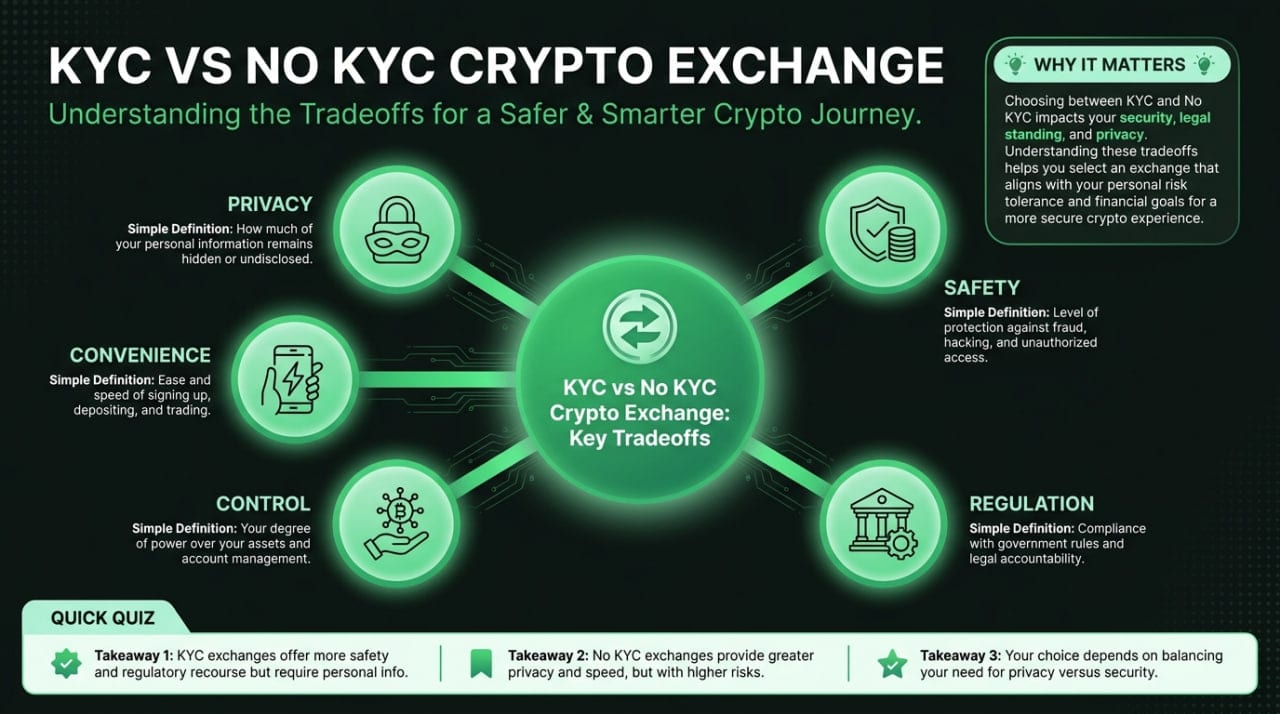
When deciding between a KYC vs no KYC crypto exchange, the core tradeoff comes down to fiat convenience versus personal privacy. Regulated platforms provide direct bank connections and account recovery, but they require you to surrender sensitive identity documents. Anonymous exchanges protect your personal data from breaches but require you to take full responsibility for your own wallet security.
Privacy and Data Collection in a KYC vs No KYC Crypto Exchange
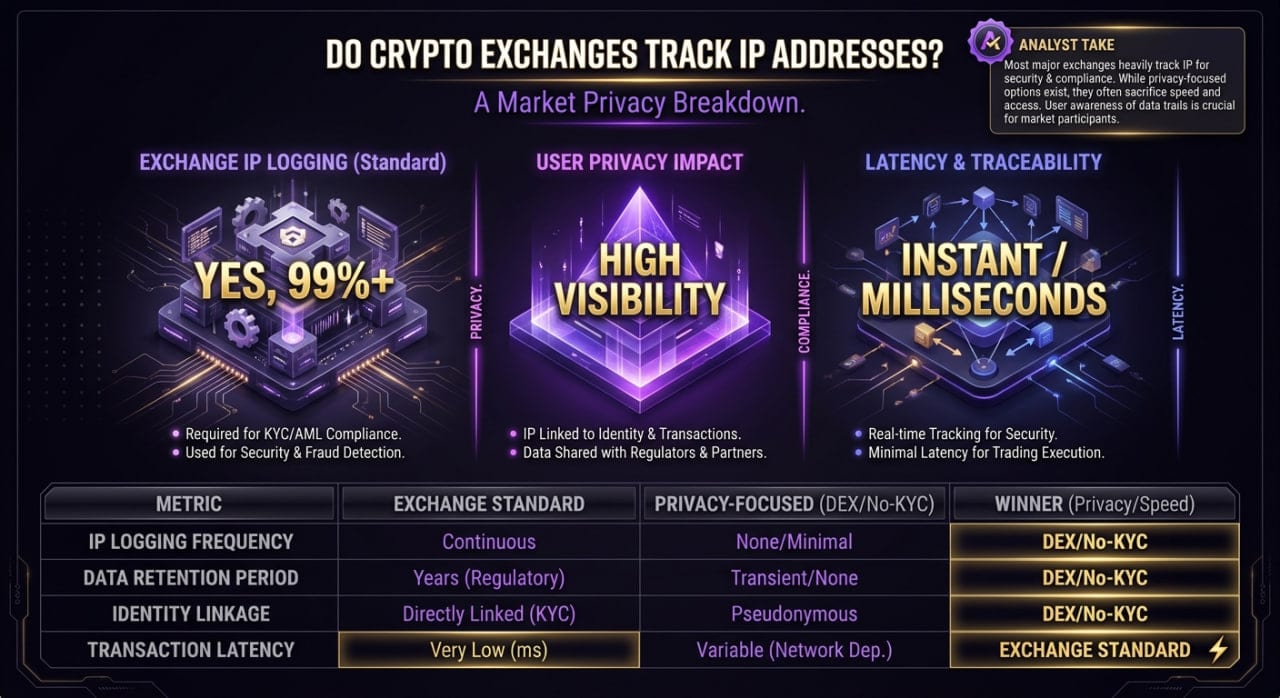
KYC (Know Your Customer) platforms operate like traditional financial institutions. They require government IDs, facial recognition scans, and proof of address before you can execute a single trade. Once verified, these exchanges log your IP address, device fingerprints, and every withdrawal address you use, often sharing this data with third-party compliance vendors. If the exchange suffers a data breach, your physical address and financial history become permanently available to hackers.
No-KYC exchanges operate on a different model, prioritizing data minimization. You interact with these platforms using only your crypto wallet addresses. Because they do not collect your name, passport, or physical address, a database leak cannot tie your real-world identity to your on-chain transaction history. However, you still need to practice good operational security, such as avoiding address reuse and managing your UTXOs (Unspent Transaction Outputs), to maintain true anonymity on public ledgers.
Account Freezes and Custody Risks
Centralized KYC exchanges hold your private keys in their own institutional wallets. This custodial model means the exchange has full control over your assets and can freeze your account at any time. They routinely use chain analysis software to flag deposits originating from coin mixers, gambling sites, or sanctioned entities. If your account is flagged, you lose access to your funds until you provide extensive documentation proving the source of your wealth.
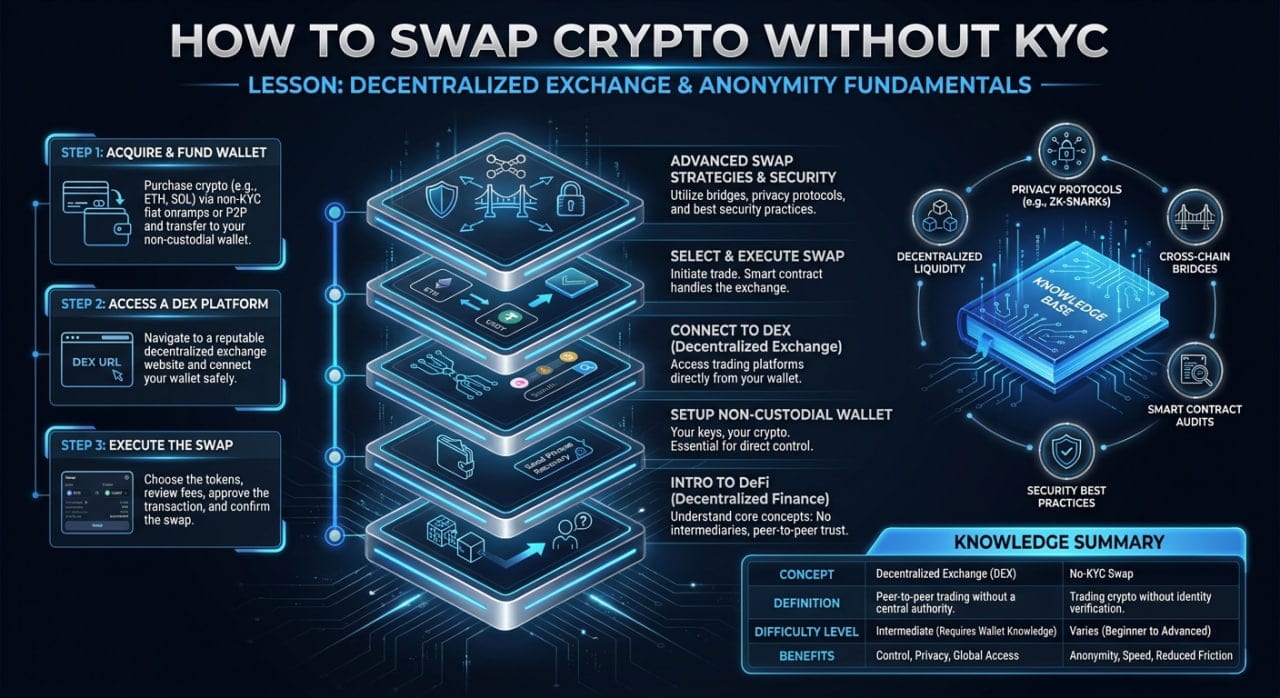
Many no-KYC platforms eliminate this risk entirely by using a non-custodial model. For example, when you use a service like MistySwap to swap BTC to ETH, you never create an account or deposit funds into a centralized custodial wallet. You simply send the exact amount to a temporary deposit address, wait for the required network confirmations, and the routing engine sends the swapped asset directly to your self-custody wallet. Because the platform never holds your funds long-term, there is no account to freeze.
Withdrawal Limits and Fiat Off-Ramps
The primary advantage of a regulated exchange is the ability to move large amounts of fiat currency. Once you pass top-tier identity verification, you can wire hundreds of thousands of dollars directly to your bank account. These platforms have deep liquidity and established banking relationships, making them the standard choice for cashing out crypto into traditional money.
No-KYC exchanges generally do not support fiat withdrawals due to strict global banking regulations. Instead, they specialize exclusively in crypto-to-crypto trades. Their trading limits are usually dictated by the available liquidity pools rather than arbitrary account tiers. If you are looking to swap BTC to USDT to lock in profits without exposing your identity, a no-KYC platform handles this seamlessly, but you will still hold crypto, not cash in a bank.
Security and Account Recovery Tradeoffs
If you forget your password or lose your two-factor authentication device on a regulated exchange, you can contact customer support, submit a new selfie, and regain access to your money. This safety net is highly appealing to users who are uncomfortable managing private keys. The exchange acts as a fallback mechanism for human error.
Using a no-KYC, non-custodial exchange shifts the entire security burden onto you. There is no customer support desk that can reverse a blockchain transaction if you paste the wrong destination address. If you lose the seed phrase to the hardware wallet you are swapping into, those funds are permanently lost. You must be comfortable managing your own keys and verifying network fees before broadcasting any transaction.
How to Choose Between a KYC vs No KYC Crypto Exchange
Your choice ultimately depends on what you are trying to accomplish with a specific transaction. Many privacy-conscious users maintain a hybrid approach, using regulated platforms strictly for fiat onboarding while keeping their main portfolio off-grid.
Use this checklist to determine which exchange model fits your immediate transaction needs:
- Use a KYC exchange if: You need to withdraw funds directly to a traditional bank account.
- Use a KYC exchange if: You want the safety net of password resets and account recovery.
- Use a no-KYC exchange if: You are swapping crypto-to-crypto and want to protect your identity from data breaches.
- Use a no-KYC exchange if: You want to maintain self-custody of your private keys at all times.
- Use a no-KYC exchange if: You want to avoid the risk of sudden account freezes based on chain analysis.
FAQ
Can a no-KYC exchange freeze my funds?
If the no-KYC exchange is custodial (meaning they hold your funds in a web wallet), they technically can freeze your assets. However, non-custodial no-KYC platforms cannot freeze your funds because they never hold your private keys. The swap occurs instantly between your self-custody wallets once the deposit is confirmed on-chain.
Do I need a VPN when using a no-KYC crypto exchange?
While no-KYC platforms do not ask for your ID, your internet service provider can still see your IP address. Using a reputable VPN or Tor masks your IP address, adding an essential layer of privacy to prevent your physical location from being logged alongside your transaction broadcast.
How do I cash out to fiat without KYC?
Cashing out to fiat without KYC is difficult due to banking regulations. Users typically rely on peer-to-peer (P2P) cash trades, Bitcoin ATMs, or purchasing gift cards with crypto. Most users prefer to swap volatile assets into stablecoins on a no-KYC platform to preserve purchasing power without touching the traditional banking system.
Are network fees higher on no-KYC exchanges?
Network fees depend entirely on the blockchain you are using, not the exchange type. However, non-custodial swaps require on-chain transactions for both the deposit and the receipt, meaning you will pay standard miner fees for both networks involved. You can review how fees work to understand the exact breakdown of network and routing costs.
Informational only — not financial, legal, or tax advice.