How to Use a Non Custodial Exchange
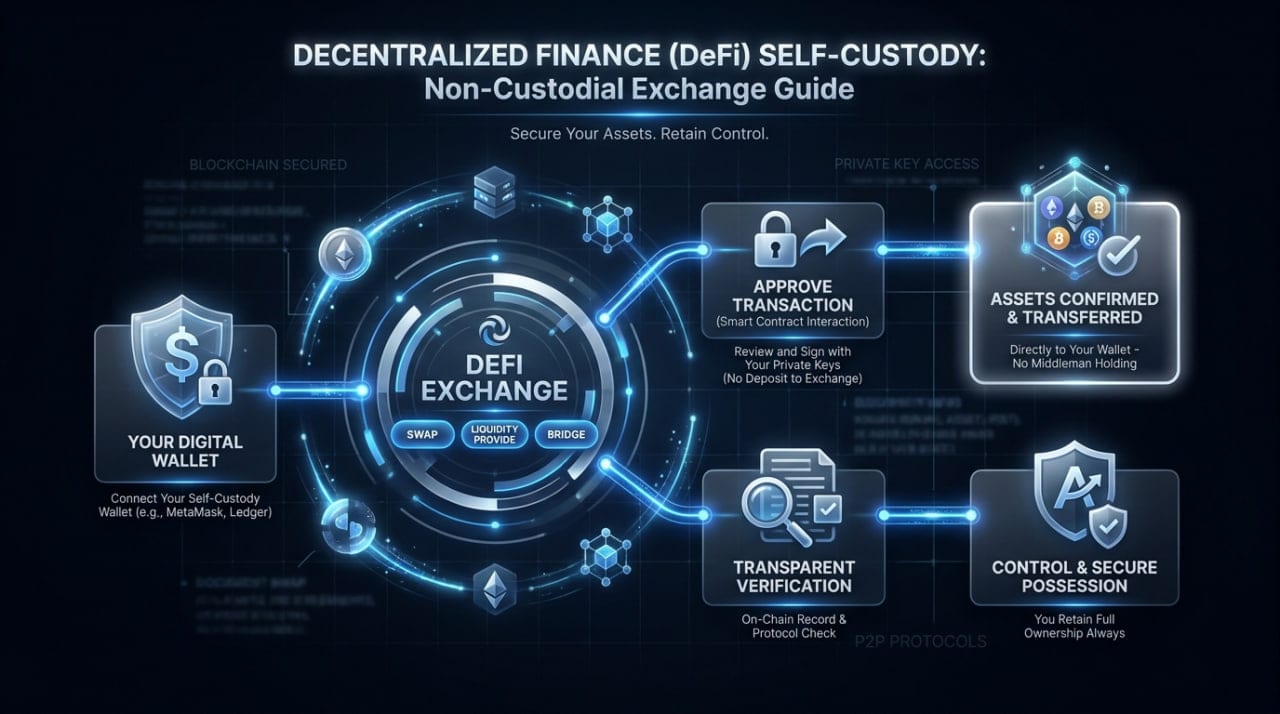
Learning how to use a non custodial exchange involves generating a swap order, sending your crypto to a temporary deposit address, and receiving the new asset directly into your own wallet. Because there are no accounts, identity checks, or login screens, the process relies entirely on you controlling your own private keys and verifying on-chain data. This guide walks you through the exact mechanics of a self-custodial swap so you can trade securely without handing over control of your digital assets.
What Happens When You Use a Non Custodial Crypto Exchange?
When you use a traditional centralized platform, you deposit funds into their corporate wallet and trade on an internal, off-chain database. A non-custodial service operates quite differently. You hold your coins in a self-custody wallet, such as Electrum, Trezor, or MetaMask, until the exact moment you want to trade. When you initiate a swap, the platform provides a unique, one-time deposit address specifically for that transaction.
Once your funds arrive and confirm on the blockchain, an automated backend immediately routes the requested coin to your receiving address. Platforms like MistySwap handle this settlement instantly without requiring you to register an account or submit personal documents. This architecture eliminates the risk of an exchange freezing your account or losing your deposits in a bankruptcy. You maintain total custody before the swap begins and immediately after the transaction clears.
Step-by-Step: How to Use a Non Custodial Exchange
Completing your first accountless swap might feel unfamiliar, but the mechanical steps are straightforward. Follow this checklist to execute a non-custodial trade successfully:
- Select the crypto you want to send and the crypto you want to receive.
- Enter the destination address from your self-custody wallet where you want to receive the new coins.
- Note the exact deposit amount and the one-time deposit address generated by the exchange.
- Send the exact amount of cryptocurrency from your wallet to the provided deposit address.
- Wait for the blockchain network to confirm your transaction.
- Receive the swapped asset directly into your destination wallet.
Always double-check your destination address before confirming the swap order. Blockchain transactions are irreversible, meaning a typo in your receiving address results in permanent loss of funds. Generating a fresh receiving address for every new swap also helps preserve your on-chain privacy. If you want to understand the technical routing happening behind the scenes, you can review exactly how the swap process works.
Navigating Network Fees and Confirmations
Since you are transacting directly on the blockchain, you must account for network fees alongside the exchange rate. You will pay a miner or gas fee to your wallet provider's network to send the initial deposit. The exchange also pays a separate network fee to send the final asset out to your destination wallet. Understanding how fees work ensures you do not encounter surprises, especially during periods of high network congestion.
Every swap requires a specific number of network confirmations before the exchange releases the new asset. Bitcoin typically requires one or two block confirmations, which can take ten to thirty minutes depending on network traffic. Faster networks, like Ethereum or Tron, usually confirm within seconds to a few minutes. Set an appropriate custom fee in your sending wallet so your transaction does not get stuck in the mempool waiting for a miner to pick it up.
Tracking Your Transaction Without Customer Support
The biggest adjustment for users leaving centralized platforms is the absence of a live chat agent to confirm a deposit arrived. Instead, you act as your own verification team using public blockchain explorers. When you send your deposit, your wallet software generates a transaction ID (TXID) or hash. This unique string of letters and numbers acts as your mathematical proof of payment.
You can paste your TXID into an explorer like Mempool.space for Bitcoin or Etherscan for Ethereum to track your deposit in real-time. The exchange order page will also dynamically update once it detects your incoming transaction on the blockchain. If you send a deposit and the exchange screen has not updated, simply check your TXID on a block explorer. Until the explorer shows the transaction as confirmed, the exchange cannot mathematically process your swap.
Common Mistakes When Using Non Custodial Exchanges
Sending funds on the wrong network is the most common error new users make. For example, if you decide to swap BTC to USDT, you must ensure you provide an ERC-20 (Ethereum network) receiving address for the Tether, not a Tron or Polygon address. Sending coins to an incompatible network address results in permanent loss because the keys for one network rarely translate to another. Always verify the token standard requested by the exchange interface.
Another frequent mistake is ignoring the minimum deposit requirement. Non-custodial platforms enforce minimums to ensure the swapped amount covers the outbound network fee required to send you the funds. If you send less than the minimum, the transaction will fail to process and the platform may not be able to refund you economically. Finally, always send the exact deposit amount requested if you selected a fixed-rate swap, as any variance will invalidate the locked price quote.
FAQ
What happens if I send the wrong amount?
If you send an amount different from what a fixed-rate order expects, the exchange will usually recalculate the swap at the current floating market rate. If the amount is below the minimum threshold, the swap will fail entirely. You will need to contact the platform's support system with your TXID, though refunds for tiny amounts often cost more in network fees than the funds are actually worth.
How long does a swap usually take?
The swap duration depends entirely on the blockchain networks involved. The actual exchange computation happens instantly, but waiting for block confirmations dictates the timeline. This can take anywhere from a few seconds on faster chains to over thirty minutes on the Bitcoin network. You can track this progress using your transaction hash on a public block explorer.
Do I need to verify my identity?
No, true non-custodial swaps do not require Know Your Customer (KYC) documentation because the platform never holds your funds in a custodial account. You interact with the routing smart contracts or backend directly from your own wallet. As long as you possess your private keys and control your addresses, you can trade freely.
Can I swap across different blockchains?
Yes, cross-chain swaps are a primary feature of these services. You can easily trade a native asset on one blockchain for a token on a completely different network, such as sending native Bitcoin to receive an ERC-20 token on Ethereum. You just must ensure your receiving wallet is configured to accept the specific network token you are requesting.
Are there hidden fees in non-custodial swaps?
Reputable platforms do not charge hidden fees, but you must factor in network gas costs. The rate quoted on the screen typically includes the platform's small service margin. You will, however, pay the standard network fee from your own wallet to initiate the deposit, which goes to miners, not the exchange.
Informational only — not financial, legal, or tax advice.