How Long Does a Crypto Swap Take?
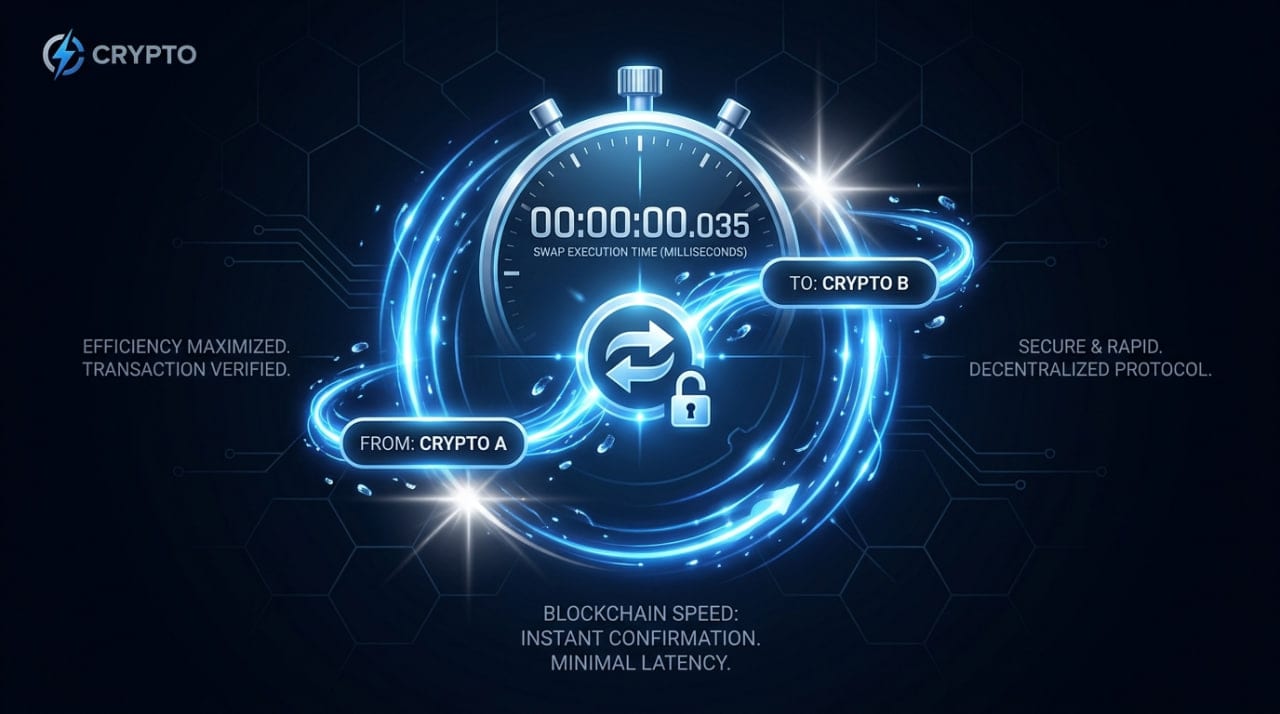
If you are wondering how long does a crypto swap take, the answer is usually between 5 and 30 minutes. This timeframe depends entirely on the block times and congestion of the specific blockchains you are trading between. Once the native network confirms your initial deposit, the actual token exchange and final payout happen almost instantly.
Exactly How Long Does a Crypto Swap Take?
When you trade directly from your own self-custody wallet, you are bound by the hardcoded rules of the blockchain. A non-custodial swap does not rely on a centralized exchange database that updates user balances instantly off-chain. Instead, actual cryptographic tokens must move across public ledgers.
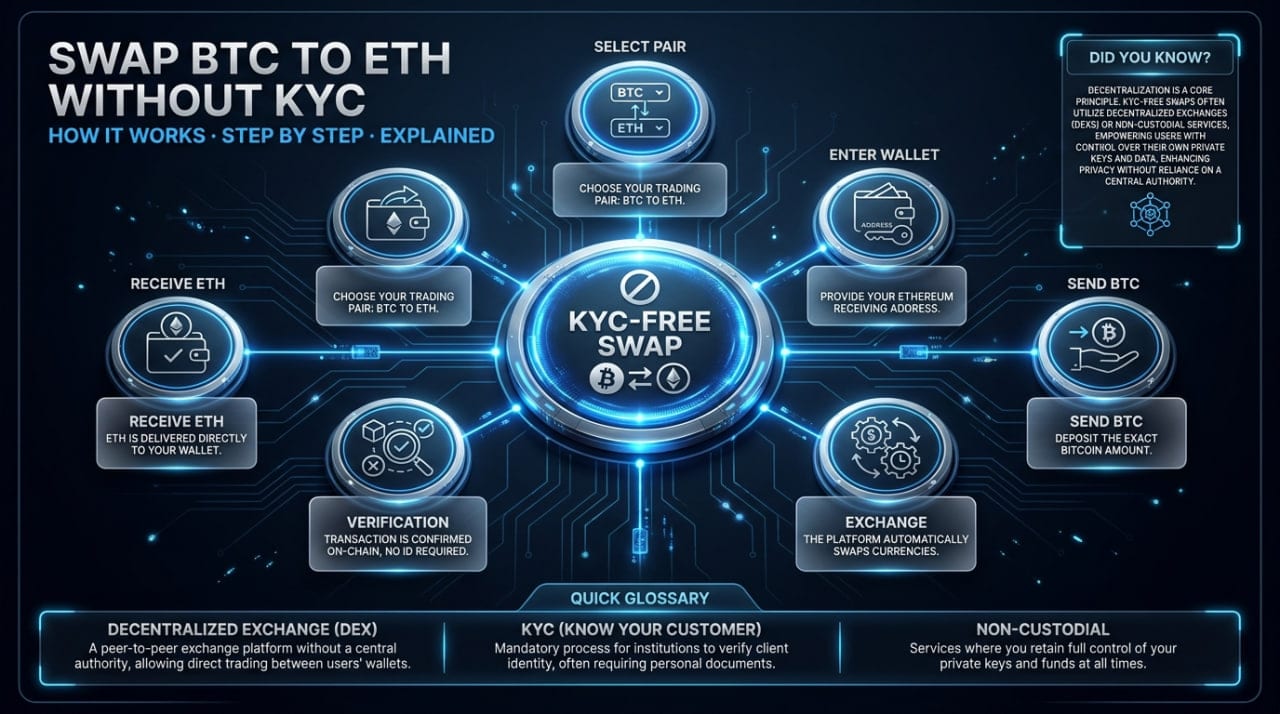
Here is exactly what happens during the waiting period of a non-custodial crypto swap:
- Broadcasting: Your wallet broadcasts the initial deposit transaction to the network mempool.
- Mining: Network validators pick up your transaction and include it in a newly mined block.
- Confirming: The swap node waits for a predetermined number of subsequent blocks to secure the deposit against network rollbacks.
- Exchanging: The routing engine instantly executes the trade at the current market rate.
- Payout: The service immediately broadcasts the newly swapped asset to your receiving wallet.
Understanding how the swap process works mechanically helps eliminate the anxiety of waiting. The delay you experience after hitting send is simply the time it takes for these five specific steps to execute on-chain.
How Block Times Impact Crypto Swap Times
Every blockchain processes and finalizes data at a different speed. Block time refers to the average time it takes for a decentralized network to bundle a batch of pending transactions and append them to the public ledger. Bitcoin targets a 10-minute block time, while Ethereum validators process a new block roughly every 12 seconds.
If you decide to swap BTC to ETH, your total wait time is a combination of both network speeds. You must wait for the Bitcoin network to mine your initial deposit, which takes a minimum of 10 minutes. Once the exchange executes, you only wait about 12 seconds for the Ethereum network to deliver your new funds to your wallet.
Faster networks like Solana, Arbitrum, or Polygon have block times measured in milliseconds. Swapping between two fast Layer-2 networks feels instantaneous. Moving funds across older Proof-of-Work chains naturally requires more patience.
Why Swap Nodes Require Block Confirmations
Getting your transaction into a single block is often not enough to trigger the payout. Blockchains occasionally experience minor reorganizations where two competing validators mine a block at the exact same time. To protect against these reorganizations and potential double-spend attacks, swap nodes wait for multiple confirmations.
A confirmation is simply another newly mined block stacked on top of the block containing your deposit. On the Bitcoin network, most non-custodial services require one to two confirmations before releasing funds, adding 10 to 20 minutes to your wait. Ethereum processes blocks much faster, but the network often requires 12 to 32 confirmations to ensure the transaction is fully irreversible.
When you use a non-custodial service like MistySwap, the routing engine automatically tracks these confirmations. As soon as the specific threshold is met, the smart contracts trigger the payout without any manual approval. Different assets require different security thresholds, which you can verify by checking all supported coins and networks.
Will Congestion Increase How Long a Crypto Swap Takes?
Sometimes, the answer to how long a crypto swap takes depends entirely on the network fee you broadcasted. When you hit send in your self-custody wallet, your transaction goes into a global waiting room called the mempool. Miners prioritize transactions that attach the highest gas fees because it maximizes their own block revenue.
If the network is heavily congested and you utilized a low custom fee, miners will ignore your transaction. Your deposit will remain stuck in the mempool until network traffic dies down or you intervene using a wallet tool like Replace-by-Fee (RBF). The exchange service cannot process your trade until your transaction successfully leaves the mempool and settles on-chain.
Understanding how fees work ensures your deposit gets picked up in the very next available block. Most modern wallets automatically calculate the optimal base fee and priority tip required for fast inclusion. Never manually lower the suggested network fee limit if you want a seamless, fast execution.
How to Track Your Crypto Swap While You Wait
Staring at a pending screen causes unnecessary anxiety for first-time self-custody users. You can always check the exact status of your trade using a public block explorer like Mempool.space for Bitcoin or Etherscan for Ethereum. Simply paste the deposit address provided by the swap service or your own transaction ID into the search bar.
The explorer will show you exactly where your funds sit in the processing queue. If the status says "Unconfirmed," your transaction is still sitting in the mempool waiting for a miner to claim it. If it shows a number of block confirmations, you just need to wait for the count to reach the swap service's required threshold.
Once the required confirmations hit, the routing engine executes the trade instantly. You can then take your destination wallet address and search it on the corresponding block explorer for your receiving chain. You will see the incoming payout transaction pending or already confirmed in your receiving wallet.
FAQ
Why is my Bitcoin swap taking longer than 10 minutes?
Bitcoin block times average 10 minutes, but this is just a mathematical target based on mining difficulty. Sometimes it takes 30 minutes or more for miners to solve a single block. Additionally, if your transaction fee was too low, you might have to wait for several blocks to pass before a miner selects your deposit.
Can I speed up a pending crypto swap?
You cannot speed up the swap node itself, but you can speed up your deposit transaction. If your initial broadcast is stuck in the mempool, you can use a wallet feature like Replace-by-Fee (RBF) to broadcast the exact same transaction with a higher fee. Once the network confirms the accelerated deposit, the actual swap executes normally.
Do centralized exchanges process swaps faster?
Centralized exchanges update internal database balances instantly, making trades appear faster on your screen. However, you still have to wait for on-chain block confirmations when initially depositing into the exchange and when finally withdrawing to your self-custody wallet. A non-custodial swap simply combines these fragmented steps into one seamless, peer-to-peer routing transaction.
What happens if the price drops while I wait for block confirmations?
Most instant swap services lock the quoted exchange rate for a specific window of time, usually between 10 and 20 minutes. If network congestion causes your deposit to arrive after this window expires, the trade will automatically execute at the current market rate. To avoid slippage during volatile market conditions, ensure you attach an adequate network fee for fast processing.
Informational only — not financial, legal, or tax advice.