Fixed vs Floating Rate Crypto Swap
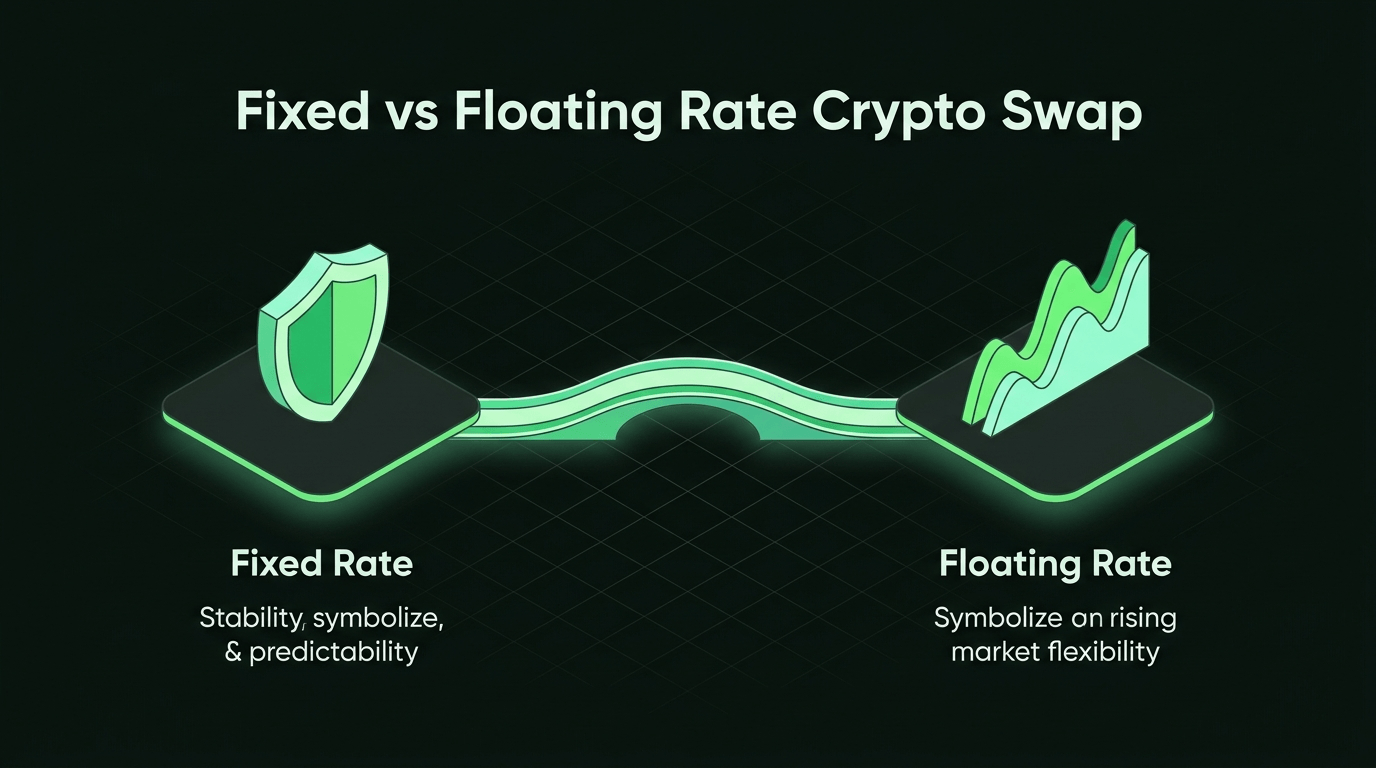
Choosing between a fixed vs floating rate crypto swap comes down to a trade-off between price certainty and getting the absolute best market payout. A fixed rate locks in your exchange value so you receive exactly what you see on the screen, while a floating rate changes with the market during the blockchain confirmation window. If you swap highly volatile assets or use congested networks, paying the slightly higher spread for a fixed rate often prevents nasty slippage surprises.
How a Fixed Rate Crypto Exchange Works
When you select a fixed rate, the instant exchange platform guarantees the exact amount of destination crypto you will receive. To provide this, the platform takes on the market risk while waiting for your deposit to confirm on the blockchain. Because they absorb the risk of a sudden price drop, they typically charge a slightly higher spread. This certainty makes fixed rates ideal when you need a precise amount of tokens to fund a smart contract or pay an exact invoice.
The Mechanics of a Floating Rate Trade
Floating rate transactions process the swap at the exact market price available at the moment your deposit receives the required network confirmations. The amount displayed when you initiate the swap is only an estimate, meaning you might receive more or less than expected. Because the user takes on the volatility risk, floating rates usually offer a tighter initial spread. If you are just accumulating funds or swapping stablecoins where volatility is minimal, floating rates generally yield a slightly better final payout.
Fixed vs Floating Rate Crypto Swap: The Mathematical Trade-off
The core math behind choosing between these two options is simple: compare the fixed rate premium to the expected volatility during the confirmation window. If a fixed rate charges a one percent higher spread, you are essentially buying insurance against the market moving more than one percent against you. On non-custodial platforms like MistySwap, how the swap process works relies entirely on on-chain settlements, meaning confirmation times are dictated by network rules. Use the following checklist to evaluate which rate makes mathematical sense for your specific swap scenario.
- Choose a fixed rate when swapping highly volatile memecoins or low-liquidity altcoins.
- Choose a floating rate when trading high-liquidity stablecoins with minimal price variance.
- Choose a fixed rate if the deposit network is congested and block times are heavily delayed.
- Choose a floating rate when depositing from fast networks where transaction settlement takes seconds.
- Choose a fixed rate when you need an exact output amount to pay a specific vendor or service.
How Network Congestion Impacts Your Swap Rate
Your choice of rate type becomes critical when network traffic spikes and block space becomes expensive. If you send a transaction with a low network fee during peak congestion, your deposit might sit unconfirmed in the mempool for hours. With a floating rate, a long delay leaves you exposed to wild price swings, potentially resulting in a significantly worse final payout. A fixed rate protects you from this scenario, provided you understand how fees work and include enough gas for the initial deposit to confirm within the platform's locked time window.
Slippage and Volatile Trading Pairs
Slippage occurs when the price of an asset changes between the time you submit a swap and the time it actually executes on-chain. High liquidity pairs experience less slippage because deep order books absorb trades without drastically moving the spot price. However, if you swap BTC to PEPE or another low-liquidity token, the time it takes to generate a single Bitcoin block allows for massive price swings. In these high-volatility scenarios, the guaranteed output of a fixed rate is almost always worth paying the upfront premium.
Market Makers and Exchange Spreads
Instant swaps do not rely on traditional order books matching buyers and sellers directly. Instead, they utilize automated market makers or aggregate liquidity pools to execute your trade automatically once your deposit clears. When offering a fixed rate, liquidity providers must hedge their positions immediately to guarantee your quoted price. This operational cost gets passed to the user via a wider spread, whereas a floating rate requires no immediate hedge, allowing the platform to offer a tighter margin. For example, if you swap BTC to ETH strictly to hold long-term, the tighter margin of a floating rate usually outweighs the need for exact precision.
FAQ
What happens to a fixed rate swap if my deposit takes too long?
If your transaction gets stuck in the mempool and misses the time window guaranteed by the exchange, the fixed rate usually expires. The platform will typically convert the transaction to a floating rate based on the current market price when the deposit finally confirms.
Do floating rates always have lower exchange fees?
Floating rates do not inherently have lower exchange fees, but they do feature a tighter spread. Because the platform does not need to hedge against market volatility during the block confirmation time, they pass that cost savings directly to the user.
Can I get a refund if slippage on a floating rate is too high?
Non-custodial instant exchanges execute swaps automatically on-chain once the required confirmations are met. Because blockchain transactions are irreversible by design, you cannot cancel or refund a swap just because the floating rate settled at an unfavorable price.
Why does the exact output matter for smart contracts?
Many decentralized applications and smart contracts require a specific amount of native gas or tokens to execute a function. If you use a floating rate and receive slightly less than the required amount due to slippage, your subsequent contract interaction will fail.
Can I switch from a fixed to a floating rate after depositing?
No, the rate structure is determined when you generate the initial swap address and agree to the transaction parameters. Because non-custodial swaps are executed automatically by backend scripts upon confirmation, the rate type cannot be altered once the blockchain broadcast occurs.
Informational only — not financial, legal, or tax advice.