Crypto Spread vs Exchange Fee: Calculating Costs
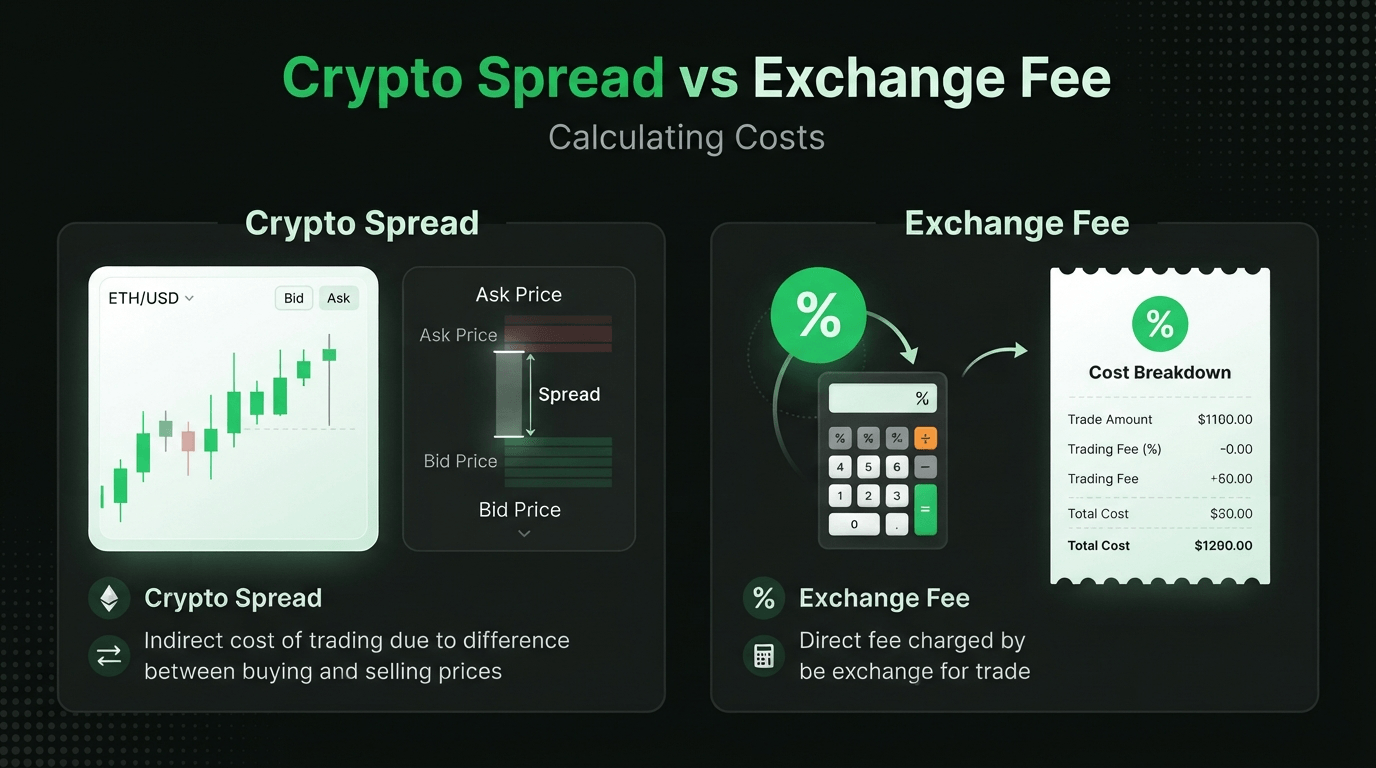
When calculating the real cost of a trade, understanding the difference between a crypto spread vs exchange fee is the only way to avoid hidden charges. An exchange fee is the explicit percentage a platform takes for facilitating the trade, while the spread is the hidden markup built into the asset's quoted price. Platforms advertising "zero fees" almost always bake massive spreads into their quotes, resulting in less crypto arriving in your final wallet balance.
Defining the Explicit Crypto Exchange Fee
An exchange fee is a transparent, flat rate or percentage charged by a platform to process your trade. Centralized exchanges typically use a maker/taker fee model, charging anywhere from 0.1% to 0.5% depending on your monthly trading volume. You can see this fee itemized on your trade receipt before you click confirm. Because the fee is clearly stated, you know exactly what the platform earns for matching your order.
Decentralized platforms often charge a flat percentage, such as 0.3%, which gets distributed to the liquidity providers supplying the tokens. In both cases, the explicit fee is mathematically predictable and applied strictly to your input amount. This transparency allows high-frequency traders and self-custody users to model their profitability accurately. Explicit fees act as the platform's primary revenue stream without requiring them to manipulate the asset's execution price.
Decoding Crypto Spread vs Exchange Fee Mechanics
To accurately evaluate a crypto spread vs exchange fee, you must look at how order books function. The spread represents the actual gap between the highest price a buyer will pay (the bid) and the lowest price a seller will accept (the ask). If you want to execute a trade immediately, you must cross the spread and accept the resting price on the opposite side of the book. Market makers profit by simultaneously offering to buy at the bid and sell at the ask, pocketing the difference.
On highly liquid trading pairs like Bitcoin and Ethereum, this gap usually amounts to just a few fractions of a percent. However, on lower volume altcoins, the spread can quickly widen, eating a significant portion of your capital before the trade even executes. Automated Market Makers (AMMs) replicate this concept through liquidity pool ratios rather than traditional order books. When you swap assets through an AMM, the spread is effectively the price impact caused by altering the ratio of tokens in the pool.
Crypto Spread vs Exchange Fee: Why "Zero Fee" is a Trap
Many retail swap apps lure users in with promises of commission-free or zero-fee trading. In reality, these platforms act as a middleman or OTC desk, artificially widening the spread to secure their profit margin. Instead of charging a transparent 0.5% exchange fee, they might quote you a purchase price that sits 2% above the global spot market rate. You pay for the trade either way, but this hidden markup makes it impossible to verify your real cost at a glance.
Comparing a crypto spread vs exchange fee reveals that paying explicit commissions is almost always cheaper than relying on hidden markups. Zero-fee brokers often route your orders to internal market makers who capture the spread difference as revenue. This practice extracts value directly from the user's final payout. By burying their profit inside the exchange rate, deceptive platforms make their service look free while quietly draining your crypto balance.
How to Calculate Your True Swap Costs
To avoid losing money to hidden markups, you must calculate the total cost of the transaction yourself. Follow these exact steps to determine your real execution cost before confirming a trade:
- Check the global spot price: Open an independent market tracker to find the current mid-market price for your target asset.
- Review the platform's quote: Enter your desired trade amount into the swap interface and note the exact amount of destination crypto offered.
- Calculate the quote's implied price: Divide your input amount by the quoted output amount to find the specific exchange rate the platform is offering.
- Compare the difference: Subtract the global spot price from your implied price to identify the exact spread markup.
- Calculate total cost: Combine the spread markup percentage, the explicit platform fee, and the blockchain network miner fee.
Once you run this calculation, you will quickly spot which platforms offer fair market execution and which rely on aggressive price markups. Never trust the estimated fiat value displayed on a swap screen, as these interfaces often use different price feeds for inputs and outputs to mask the spread. Always do the math using the raw token amounts.
Transparent Rates in Non-Custodial Swaps
Privacy-conscious users generally prefer non-custodial services where trades happen directly from wallet to wallet without central account balances. Understanding how the swap process works is essential for grasping the real costs involved. You generate a specific deposit address, send your funds, and wait for the underlying blockchain confirmations. Because the platform does not hold your funds in a custodial database, the execution depends entirely on real-time on-chain routing.
A reliable non-custodial service like MistySwap focuses on transparent exchange rates rather than hiding behind zero-fee illusions. By clearly showing the estimated output before you send your deposit, users can evaluate how fees work and verify the exact market rate. Transparent routing ensures that whether you are trading major caps or swapping smaller tokens, you receive a mathematically fair output.
Furthermore, non-custodial swaps eliminate the hidden withdrawal fees that centralized exchanges frequently use to trap users. When you swap BTC to USDT, the destination tokens are sent straight to your self-custody wallet. The quote you accept factors in the necessary network transaction fees to broadcast the payout. This straightforward mechanism prevents your funds from being held hostage by surprise withdrawal charges.
Minimizing Slippage and Network Costs
Beyond the base spread and platform fee, self-custody users must account for slippage and network gas. Slippage occurs when the available market liquidity is too thin to fill your entire order at the initial quoted price. As your order eats through the order book or AMM pool, the price worsens, resulting in fewer tokens received. Large market orders are especially vulnerable to high slippage.
On-chain traders must also remain vigilant about Miner Extractable Value (MEV) bots that track public mempools. These automated bots execute sandwich attacks by artificially pushing the price up right before your trade executes, then selling immediately after. MEV bots profit directly from the slippage tolerance you set on decentralized exchanges. Using private RPC endpoints or platforms that protect order flow can mitigate this risk.
Finally, when you trade directly from your hardware wallet, you must pay the underlying blockchain network fees for both the deposit and the payout. A trade with a low explicit fee can still become wildly expensive if the target network is heavily congested. Always monitor block space demand and try to execute non-urgent swaps during periods of low network activity to preserve your capital.
FAQ
Why did I receive less crypto than the quoted price?
If you received less than expected, you likely experienced slippage during the transaction or the platform deducted the network miner fee from the final output. On highly volatile days, the global market price can shift dramatically between the time you initiate the trade and when the blockchain confirms it. Check if your chosen platform offers fixed-rate swaps if you want to lock in the exact output price beforehand.
Is it better to pay a flat fee or a spread?
It is generally better to pay a transparent explicit exchange fee rather than relying on a widened spread. Transparent fees allow you to accurately calculate your cost basis for tax purposes and compare routing efficiency across different platforms. Hidden spreads are strictly designed to obscure the true cost and almost always result in higher total charges.
How do network fees impact the final trade cost?
Network fees, commonly called gas, are paid directly to blockchain miners or validators to process your transaction. This cost is entirely separate from the exchange's own revenue and fluctuates based on network congestion. You must add the network fee to the platform's spread and base fee to calculate the true total cost of acquiring an asset.
What is slippage and how does it relate to spread?
While spread is the current resting gap between the buying and selling price, slippage is the active change in price that occurs while your specific trade is executing. Large volume orders deplete the available liquidity at the best price, forcing the remainder of the order to fill at progressively worse prices. Both slippage and spread increase the total cost of the swap, directly reducing the final amount of tokens you receive.
Informational only — not financial, legal, or tax advice.