On Chain vs Off Chain Crypto Swap
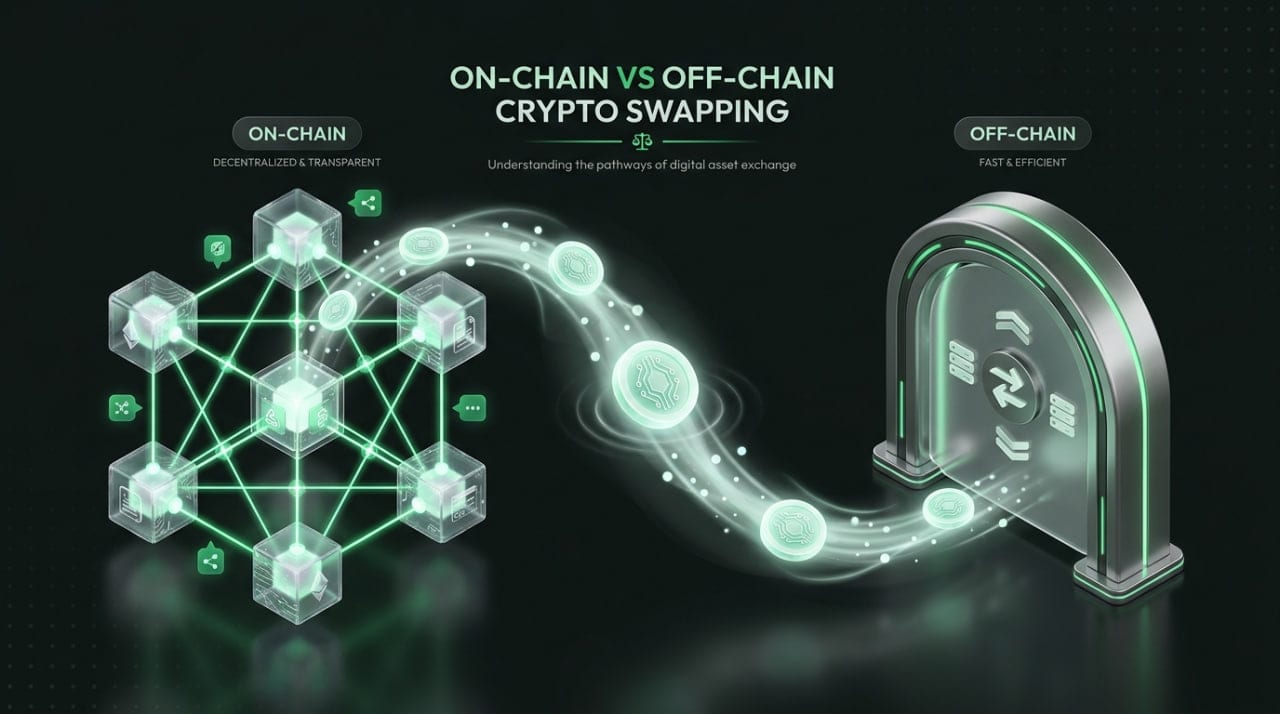
When you execute an on chain vs off chain crypto swap, the main difference is whether your trade settles publicly on the blockchain or privately inside an exchange's internal database. On-chain swaps broadcast your transaction to a decentralized ledger, allowing anyone to verify the transfer using a block explorer. Off-chain swaps happen inside the closed database of a centralized exchange, meaning the actual crypto never moves on the network until you request a withdrawal.
Internal Ledgers: The Off Chain Crypto Swap
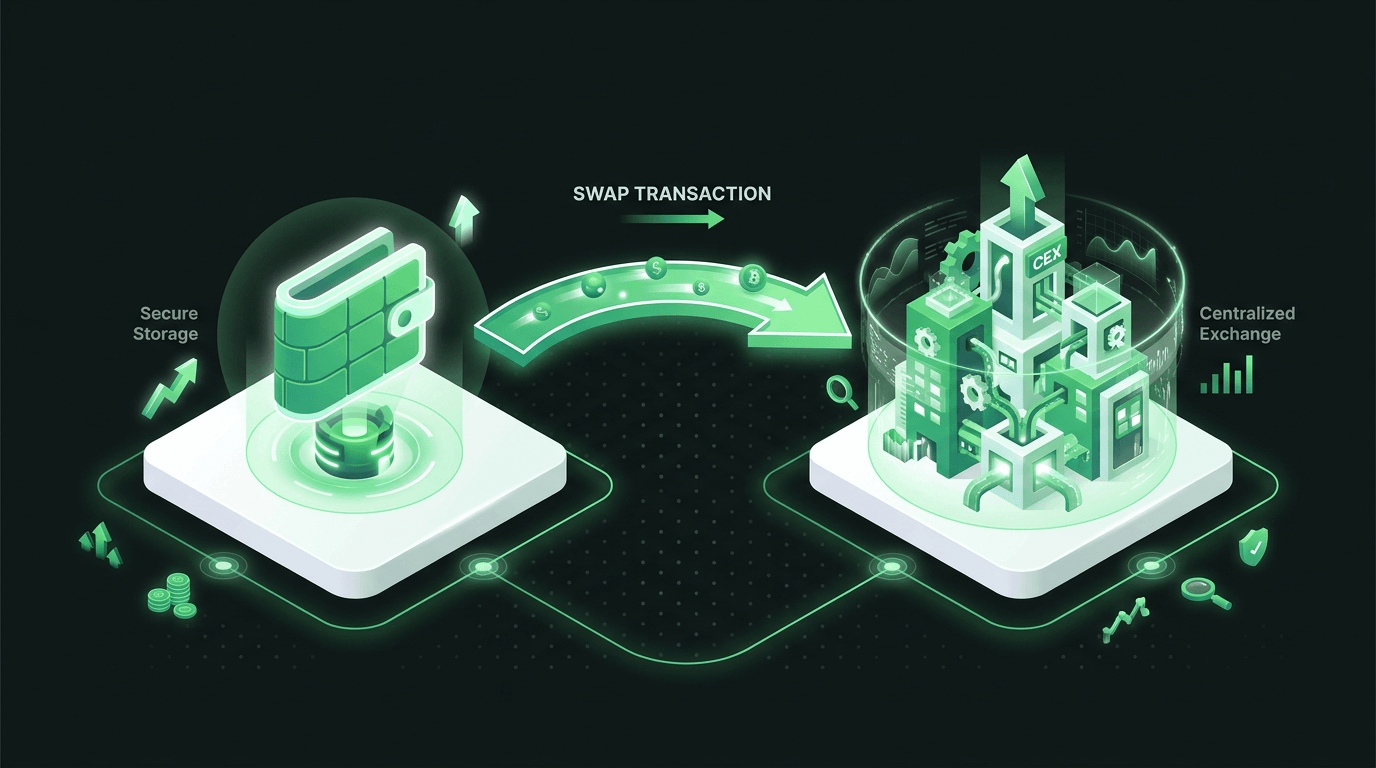
When you deposit Bitcoin into a centralized exchange (CEX) like Binance or Coinbase, the exchange takes custody of your funds and credits your internal account balance. If you decide to trade that Bitcoin for Ethereum, the exchange simply updates its internal SQL database. It deducts BTC from your account ledger and adds ETH.
No actual cryptocurrency moves on the blockchain during this internal trade. Because the transaction bypasses the blockchain, you do not pay miners network fees for the trade itself. The exchange acts as a black box, matching your order with other users internally. The only time an off-chain transaction hits the public ledger is when you initially deposit the funds or finally withdraw them to your own self-custody wallet.
Public Ledgers: The On Chain Crypto Swap
An on-chain swap executes the trade directly on the public blockchain networks involved. If you trade tokens on a decentralized exchange (DEX) like Uniswap, smart contracts handle the swap entirely on the Ethereum ledger. If you are swapping native assets across different blockchains, non-custodial instant exchanges facilitate the transfer between independent networks.
For example, when using a service like MistySwap to swap BTC to ETH, you send Bitcoin directly from your hardware wallet to a provided deposit address. Once the Bitcoin network confirms your deposit, the service automatically sends Ethereum from its liquidity pool directly to your self-custody Ethereum address. Every step generates a unique transaction hash that you can independently verify on block explorers like Mempool.space or Etherscan. You never relinquish custody of your private keys to a third-party account.
Key Differences: On Chain vs Off Chain Crypto Swap
To understand exactly what happens to your assets during a trade, look at the underlying mechanics. Here is a direct comparison of the two methods:
- Settlement location: On-chain swaps settle on the public blockchain ledger; off-chain swaps settle in a centralized exchange's private database.
- Custody of funds: On-chain platforms are non-custodial, leaving you in control of your private keys; off-chain platforms require you to surrender custody to the exchange.
- Verifiability: On-chain trades generate a public transaction ID (TXID) you can track; off-chain trades are hidden inside a proprietary order book.
- Anonymity and KYC: On-chain protocols typically require no identity verification; off-chain exchanges heavily enforce Know Your Customer (KYC) rules.
- Network fees: On-chain swaps require paying miner or validator fees for every transaction; off-chain swaps rely on flat trading fees set by the exchange.
Privacy and Custody Trade-Offs
Centralized off-chain exchanges require you to link your real-world identity to your trading activity. Even though the trades themselves are hidden in an internal database, the exchange logs your IP address, device IDs, and withdrawal addresses. If that exchange experiences a data breach or faces a subpoena, your complete trading history becomes exposed. You also carry counterparty risk, meaning you lose your coins if the exchange halts withdrawals, freezes your account, or goes bankrupt.
On-chain swaps eliminate counterparty risk because you hold the private keys before and after the trade. There is no account creation, meaning your personal identity remains decoupled from your swap activity. However, because on-chain transactions are permanent and public, you must practice strict wallet hygiene. Reusing addresses or linking a hardware wallet directly to known KYC endpoints can degrade the privacy benefits of non-custodial swapping.
Managing Network Fees and Execution Speeds
Because on-chain swaps interact directly with the blockchain, they incur network fees, often called gas. During periods of high network congestion, swapping assets directly on the blockchain can become expensive. Centralized exchanges avoid this by batching transactions and keeping trades off-chain, which makes them faster and cheaper for high-frequency day traders.
However, for users who prioritize self-custody and privacy, paying the network fee is the cost of absolute security. When you trade on-chain, you also gain access to a wider variety of assets that centralized exchanges might refuse to list. Whether you want to swap into a stablecoin or swap BTC to PEPE, non-custodial on-chain platforms route the assets directly to your wallet without seeking permission from a centralized compliance department.
FAQ
Can you trace an off-chain crypto swap?
Publicly, no. Because the trade happens in a private database, blockchain analysis tools cannot see the swap itself. However, the exchange operators and law enforcement agencies with a subpoena can view the entire internal ledger, connecting your deposits, trades, and withdrawals to your verified identity.
Do on-chain swaps require an account?
No, true on-chain swaps do not require you to create an account or provide an email address. You simply connect a Web3 wallet to a smart contract, or send funds to a specific deposit address for a non-custodial instant swap. The blockchain itself acts as the secure settlement layer.
Why are off-chain swaps faster?
Off-chain swaps execute instantly because they only require a database update on an exchange's local server. On-chain swaps must wait for the respective blockchain networks to process and confirm the transaction. The speed of an on-chain swap depends entirely on the block times and confirmation requirements of the networks you are using.
Do I have to pay mining fees for both networks in a cross-chain swap?
Yes, moving assets between two different blockchains requires a transaction on each respective network. If you swap BTC to USDC, a Bitcoin miner must confirm your deposit, and an Ethereum validator must process the USDC payout. Non-custodial swap platforms usually calculate and bundle these network costs into the final exchange rate.
Informational only — not financial, legal, or tax advice.