What Is a Crypto Dusting Attack?
If you recently noticed a tiny, unexpected deposit in your wallet, you are likely wondering what is a crypto dusting attack and whether your funds are safe. In short, a dusting attack is a blockchain surveillance technique where attackers send microscopic amounts of cryptocurrency to thousands of addresses. Their goal is not to steal your coins directly, but to trick your wallet into combining that "dust" with your other funds, permanently unmasking your privacy.
How a Crypto Dusting Attack Works on Bitcoin and UTXO Chains
To understand dusting, you must first understand how blockchains like Bitcoin track balances. A Bitcoin wallet is like a physical wallet filled with digital banknotes of different denominations, technically called Unspent Transaction Outputs (UTXOs). When you receive 0.5 BTC and 0.2 BTC in separate transactions, your wallet holds two distinct UTXOs rather than a single merged account balance.
To execute a dusting attack, a blockchain analytics firm or hacker sends a tiny fraction of a coin—often just a few hundred satoshis—to your address. This tiny deposit sits in your wallet as an independent UTXO, looking completely harmless among your larger balances. The attacker then monitors the public ledger, waiting for you to move funds out of that wallet.
Casual users rarely notice these tiny deposits because most wallet software hides the underlying UTXOs and displays a single total balance. When you look at your wallet interface, a deposit of 0.00000546 BTC barely changes your displayed net worth. However, that microscopic coin acts as a digital tracking beacon the moment it leaves your wallet in a future transaction.
Why Sleuths Use Crypto Dusting Attacks to Dox Wallets
The danger of dust lies in how cryptocurrency wallets construct outgoing transactions. When you send Bitcoin to someone, your wallet automatically selects and combines multiple UTXOs from your balance to cover the total payment amount and the miner fee.
Chain analysts rely on the "common-input-ownership heuristic," a core assumption in blockchain surveillance. This rule states that all inputs used in a single transaction belong to the exact same private key owner. Because a user must sign for every input in a transaction, observers can mathematically prove that the same person controls all the sending addresses.
If your wallet automatically bundles the attacker's dust UTXO with your larger, clean UTXOs to make a payment, the trap springs. Surveillance software instantly clusters those addresses together, linking your previously anonymous addresses to a single identity. If even one address in that cluster is tied to a KYC-verified exchange account, your entire transaction history is doxed.
Several groups use dusting to map network activity for different purposes. Blockchain analytics companies use these techniques to build surveillance databases that they sell to exchanges, tax agencies, and law enforcement. At the same time, criminal hackers use dusting to identify wealthy wallet clusters so they can target the owners with phishing emails, extortion, or physical threats.
EVM Account Models vs. UTXO Dusting
Dusting operates differently depending on the underlying blockchain architecture. On UTXO-based chains like Bitcoin, Litecoin, and Dogecoin, dust is strictly a privacy tracking tool used to map wallet clusters. The network architecture itself forces users to consume inputs, making consolidation heuristics highly effective for surveillance teams.
On account-based EVM networks, however, receiving tiny token deposits or random NFTs is usually an advertising lure or a phishing scam rather than a clustering attempt. Attackers send worthless tokens to your Ethereum address hoping you will visit a malicious smart contract link in the token name or approve a drainer transaction. Because Ethereum uses an account balance model rather than UTXOs, sending ETH from your account does not accidentally cluster separate inputs together.
When you swap BTC to ETH or move funds between different network architectures, understanding these operational differences helps you evaluate the actual risk of unexpected deposits. You can check all supported coins and networks to see which blockchains rely on UTXOs versus account-based accounting models.
How to Stop a Crypto Dusting Attack from Tracking You
To neutralize dust, you must prevent your wallet from ever spending the attacker's UTXO. Once the dust is frozen or ignored, the attacker's tracking beacon becomes completely useless.
- Enable Coin Control: Switch to an advanced self-custody wallet like Sparrow, Electrum, or Wasabi that gives you manual selection over transaction inputs.
- Identify the Dust UTXO: Locate any tiny, unsolicited deposits in your transaction history (typically under 546 satoshis on Bitcoin).
- Freeze or Label the Output: Use your wallet's interface to freeze, lock, or mark the dust UTXO as "Do Not Spend."
- Spend Clean Inputs Only: When making transactions, manually select only your legitimate, un-frozen UTXOs to ensure the dust is never combined with your funds.
- Use Fresh Addresses: Generate a new receive address for every transaction to minimize linking risks across your wallet.
Once locked, that fraction of a cent will sit in your wallet forever without compromising your identity. Advanced privacy users who need to trade clean UTXOs without creating KYC clusters often rely on no-account swap tools. For example, using a non-custodial service like MistySwap allows you to trade from a clean address without linking your wallet to a real-world identity; you can learn more about how the swap process works to see how instant, accountless routing protects your on-chain footprint.
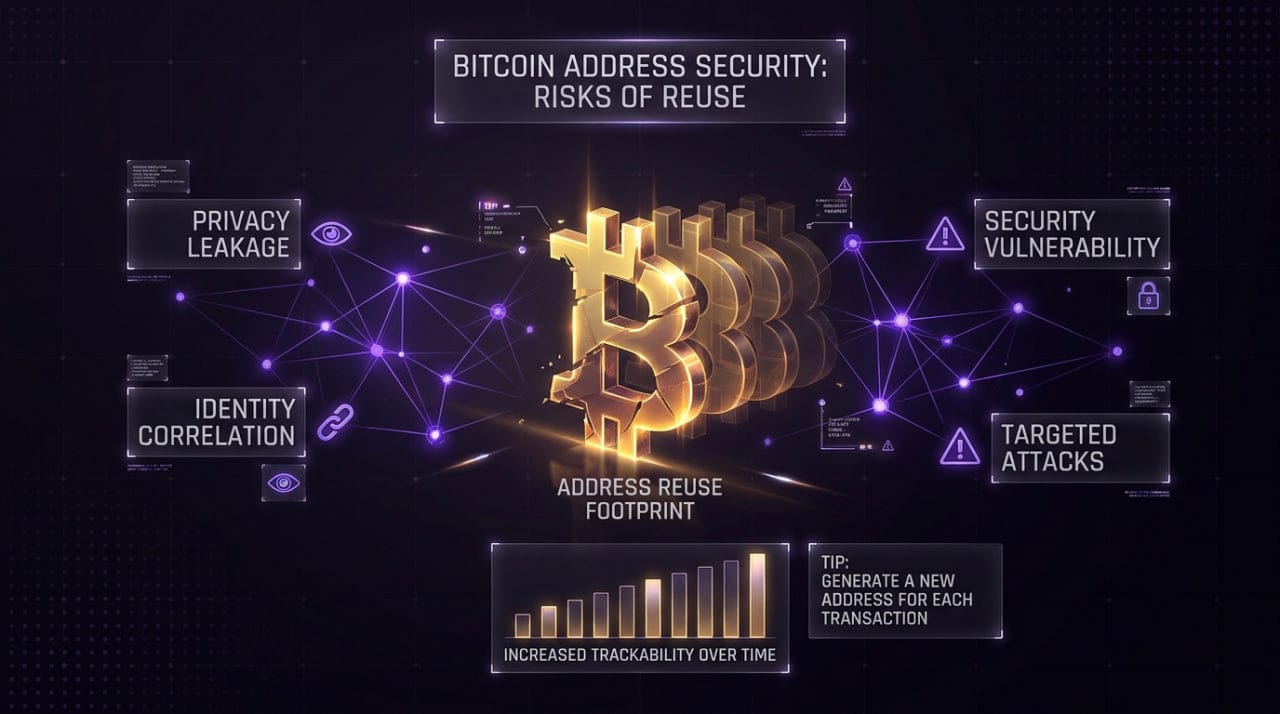
Address reuse makes dusting attacks significantly more damaging. If you use a single static Bitcoin address for all your incoming transactions, anyone can easily see your entire balance and target you with dust. Hierarchical Deterministic (HD) wallets automatically generate a fresh address for every payment, which isolates incoming UTXOs and limits the exposure caused by a single dusted address.
The Economic Limit of Dust and Network Fees
Bitcoin nodes enforce a minimum transaction output size known as the "dust limit." This rule prevents users from spamming the network with transactions that cost more in miner fees to process than the intrinsic value of the coins being sent. If a transaction output falls below this threshold, standard nodes reject it from the mempool.
For standard Bitcoin transactions, the dust limit is currently 546 satoshis for P2PKH addresses and 294 satoshis for SegWit native addresses [HUMAN VERIFY: current default SegWit/Taproot dust limit thresholds in Bitcoin Core]. Attackers must send amounts slightly above this limit so the network validates and confirms their tracking transactions. Any deposit smaller than these thresholds cannot be broadcast on the base layer.
Ironically, because network fees usually exceed the value of these micro-deposits, attempting to spend the dust alone would cost you money. This economic reality works to your advantage when using automated wallet software. If network fees are high, simple wallets will naturally ignore tiny UTXOs because including them in a transaction would increase the miner fee by more than the dust is worth.
FAQ
Can a dusting attack steal my cryptocurrency?
No, a dusting attack cannot directly steal the coins out of your wallet. Your private keys remain secure, and the attacker has no control over your funds. The threat is strictly to your privacy, as spending the dust can link your addresses and reveal your financial history.
Should I send the dust back to the attacker?
Never attempt to send dust back to the sender or transfer it to a burn address. Doing so creates an on-chain transaction that consumes your wallet's UTXOs, which is the exact consolidation trap the attacker wants to trigger. Simply ignore the deposit and freeze the output using your wallet's coin control features.
Do hardware wallets protect against crypto dusting attacks?
Hardware wallets protect your private keys from offline and online theft, but they do not automatically stop dusting attacks. Many default hardware wallet interfaces automatically bundle UTXOs when you send funds, which can accidentally spend dust. To stay safe, connect your hardware wallet to third-party software that supports manual coin control.
What is the difference between dust and a legitimate small payment?
Legitimate small payments usually come from known sources, such as mining pool payouts, test transactions you initiated, or lightning channel closings. Dust attacks arrive unexpectedly from unknown addresses, typically as microscopic amounts just above the network dust limit. If you do not recognize the sender of a tiny transaction, treat it as dust and freeze it.
Informational only — not financial, legal, or tax advice.