Are Crypto Mixers Traceable?
When privacy advocates ask, are crypto mixers traceable, the short answer is yes—blockchain forensics firms regularly unmask users of both Bitcoin tumblers and smart contract mixers like Tornado Cash. Because public blockchains record every transaction permanently, investigators can use volume analysis, timing attacks, and tainted inputs to connect your original deposit to your final withdrawal address. Rather than providing absolute privacy, mixing services often paint a massive red target on your funds.
Why Are Crypto Mixers Traceable by Blockchain Forensics?
Mixers attempt to break the link between a sender and receiver by pooling funds from multiple users, scrambling them, and sending them to new addresses. In theory, this creates an anonymity set where your coins become indistinguishable from anyone else's. In practice, public blockchains act as permanent, fully transparent ledgers where metadata never disappears. Every deposit address, network fee, and withdrawal timestamp remains visible forever, giving analysts a massive dataset to parse.
Forensic companies like Chainalysis, Elliptic, and CipherTrace rely on advanced clustering algorithms to trace these on-chain paths. They do not need to break cryptography to trace mixers; they simply analyze user behavior, transaction metadata, and standard network heuristics. If you deposit 1.45 BTC into a tumbler and withdraw 1.44 BTC (after fees) to a new address a few hours later, the amounts themselves give away your identity. Even if the mixing pool delays the transaction or splits the outputs, the overall on-chain footprint remains mathematically linkable through careful graph analysis.
Common Deanonymization Tactics Used on Tumblers
Timing attacks are one of the most effective ways investigators trace tumbled coins. Most users lack the patience to wait days or weeks to access their funds, so they set short time delays on their mixer withdrawals. If a forensics tool sees a specific amount enter a mixing pool and a corresponding amount leave the pool shortly after, the connection is trivial for an algorithm to flag.
Volume analysis operates on a similar principle but focuses on precise transaction sizes. Because users rarely tumble perfectly round numbers, highly specific amounts like 3.14159 ETH entering and leaving a mixer stick out immediately. Even if you split the withdrawal across multiple addresses, forensics tools simply sum the outputs from the mixer within a specific time window. If the total mathematically matches your initial deposit minus the standard mixer fee, the anonymity set is completely broken.
Poor change management also destroys user privacy during the tumbling process. When you send funds to a mixer from a hardware wallet, you often generate a "change" transaction that returns unmixed dust back to your original address. If you later consolidate that leftover change with the freshly mixed outputs to pay a network fee, you instantly link your old identity to your new destination wallet.
The Centralized Exchange (CEX) Taint Problem
Even if you manage to execute a perfect tumble without making a user error, the funds themselves carry a permanent, cryptographic stain. Blockchain nodes recognize the exact smart contract addresses used by Tornado Cash and the centralized wallets operated by known Bitcoin mixers. When funds pass through these specific entities, blockchain explorers and exchange compliance systems automatically flag the outputs as high-risk or tainted.
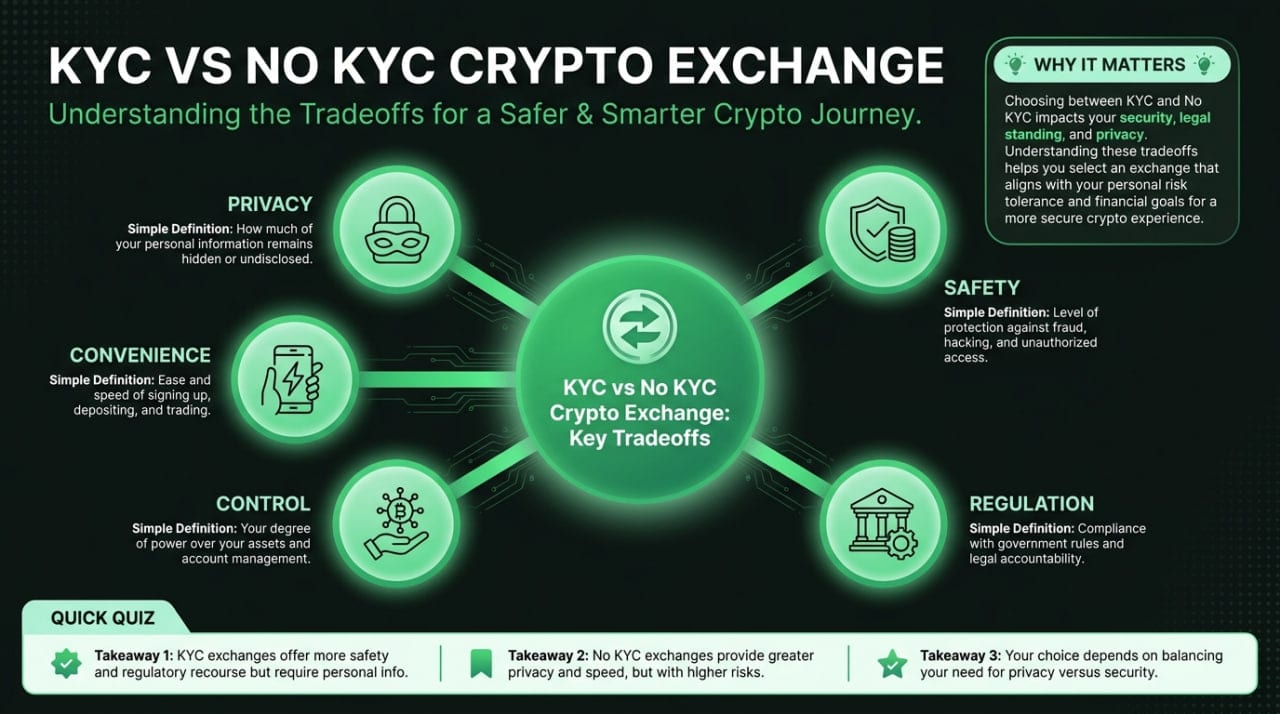
If you attempt to deposit these mixed coins into a regulated centralized exchange (CEX), you will almost certainly trigger an automated compliance freeze. Exchanges actively monitor incoming transactions using Know Your Transaction (KYT) software to comply with anti-money laundering regulations. Your account will likely be locked, and compliance officers will force you to provide a detailed source of funds declaration before you can access your money. In many cases, the exchange will simply close your account and force a withdrawal to an external wallet.
Instead of hiding your wealth, using a mixer alerts every centralized entity that you are actively trying to obscure your transaction history. This aggressive on-chain behavior often draws significantly more scrutiny than simply transferring funds directly between standard wallets.
If Crypto Mixers Are Traceable, What Is the Privacy Alternative?
Because mixing the same coin leaves an obvious trail, a cleaner privacy strategy relies on cross-chain swaps using base-layer privacy networks. Instead of tumbling Bitcoin through a centralized service on a public ledger, you can swap it into a privacy-preserving asset like Monero (XMR) on an entirely different blockchain. Monero uses ring signatures, stealth addresses, and confidential transactions to hide the sender, receiver, and transfer amount by default at the protocol level.
By moving assets across blockchains, you completely break the deterministic link that plagues single-chain tumblers. A practical approach is using non-custodial, No-KYC instant exchanges to facilitate these network hops. For example, using a service like MistySwap allows you to execute these trades directly from your own wallet. You simply send your deposit to a provided address and receive the swapped asset at your destination, operating entirely peer-to-peer. Before executing a trade, you should verify all supported coins and networks to ensure the destination chain fits your specific privacy model.
If you eventually need a transparent public ledger asset again, you can swap your privacy coins back into a fresh wallet. For instance, if you require stablecoins for trading, you could swap BTC to USDC by bridging through a privacy-coin intermediary first. Because the privacy coin breaks the on-chain link between the two separate blockchains, your final receiving address holds clean funds with no connection to your original wallet or any known tumbler contracts.
Key Steps for Breaking On-Chain Links
If you want to maintain strict self-custody and avoid the forensic risks of traceable tumblers, follow these operational security practices when swapping assets:
- Use a fresh destination wallet: Never send newly swapped funds to an address you have previously used, funded, or linked to an exchange identity.
- Cross blockchain networks: Swap your public asset into a base-layer privacy coin (like Monero) to sever the on-chain transaction graph entirely.
- Randomize your swap amounts: Avoid swapping round numbers or your exact total balance; break the transaction into smaller, randomized chunks over several days.
- Utilize non-custodial infrastructure: Stick to No-KYC, decentralized, or instant swap services where you control your own private keys throughout the entire process.
- Separate network fee funding: Fund your new wallet's gas fees (ETH, SOL, etc.) from an entirely different, unlinked source to avoid tying your old and new wallets together.
Understanding exactly how the swap process works across different networks is critical for ensuring you do not accidentally leak metadata during a decentralized trade.
FAQ
Are coin mixers illegal to use?
The legality of mixers depends entirely on your jurisdiction, but governments are increasingly cracking down on their operators. The US Treasury has sanctioned specific smart contracts like Tornado Cash, making it illegal for US persons to interact with those specific addresses. Using generic non-sanctioned mixers is generally legal in most places, though it heavily violates the terms of service of almost all regulated financial platforms.
Can police track Tornado Cash?
Yes, law enforcement and forensic firms successfully track Tornado Cash transactions by relying on user error and timing analysis. If a user withdraws the exact amount they deposited minus fees, withdraws too quickly, or uses the same IP address for both deposit and withdrawal, the connection is exposed. Furthermore, interacting with a sanctioned contract permanently taints the wallet address involved, making it highly visible to authorities.
Does using a new wallet address prevent tracking?
Simply generating a new wallet address on the same blockchain does not prevent tracking if the funds originate from your old wallet. Blockchain explorers will show a direct transfer from Wallet A to Wallet B, permanently linking the two entities in the public ledger. To truly break the link, the funds must bridge through a privacy-focused network that obfuscates the transaction graph.
How long does exchange taint last?
Exchange taint is permanent because public blockchains are immutable ledgers that never delete transaction history. If an address interacts with a known mixer, that transaction will be visible forever to anyone running a node. Even if you hold the mixed coins for five years, a centralized exchange's compliance software will still flag the deposit the exact moment it arrives.
Informational only — not financial, legal, or tax advice.